
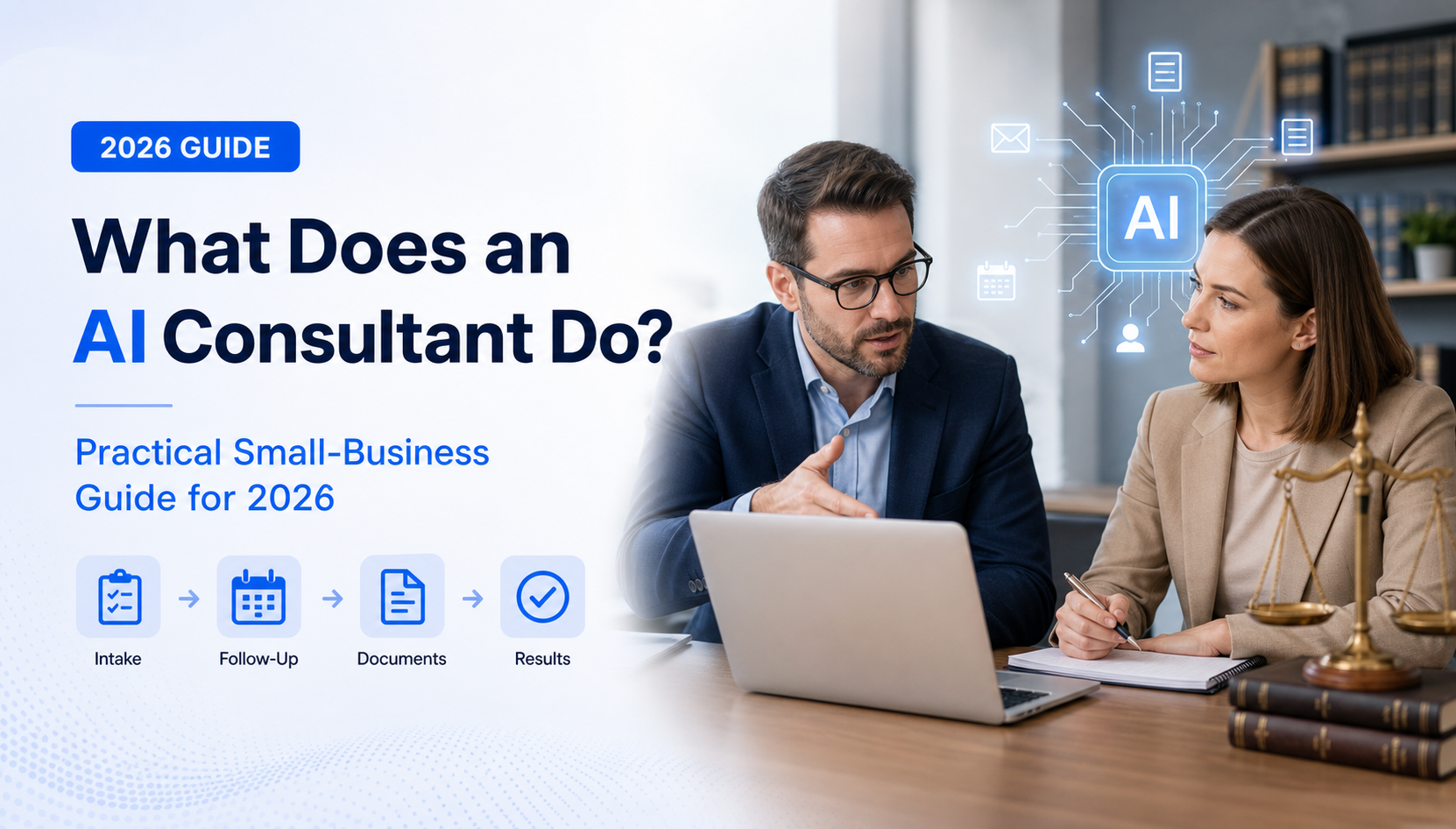
An AI consultant helps your business figure out which problems AI can actually solve, builds the workflows to solve them, protects your data along the way, and makes sure your team can use the result without breaking anything.
That is the short answer. But if you are a small business owner in the South Bay or greater Los Angeles area wondering whether hiring one is worth it, you deserve a longer, more honest explanation — one that does not assume you already know what a “workflow” or “agentic AI” means.
This guide walks through What Does an AI Consultant Do from every practical angle: what they look for, what they build, what they should never do, and how to decide whether your business actually needs one right now. If you want the broader decision framework first, the AI Consulting for Small Business guide is a useful companion.
🔑 Key Takeaways
- What Does an AI Consultant Do goes far beyond recommending tools — it starts with mapping your existing workflows.
- A good consultant finds the two or three processes where AI saves the most time before touching anything else.
- Data protection, human review, and staff training are non-negotiable parts of any responsible engagement.
- The Goldman Sachs 2026 Small Business survey found most small businesses are adopting AI but still need training and support to unlock real value.
- The answer to What Does an AI Consultant Do is not one thing — it is a structured process that ends with measurable results.
- You do not need enterprise budgets. Many South Bay small businesses start with a focused 30-day engagement.
Table of Contents
What an AI Consultant Actually Does
When someone asks What Does an AI Consultant Do, the most common assumption is that the consultant shows up, recommends a few AI tools, and leaves. That is not consulting. That is a product demo.
A real AI consultant starts by understanding your business — not AI. They want to know where your time goes, where your leads fall through the cracks, where your team is doing repetitive work that a well-designed system could handle, and where a mistake would cost you a customer or a compliance problem.
Only after that diagnostic work does the question of tools even come up. And by that point, the tool choice is almost secondary to the workflow design around it.
Here is a practical breakdown of What Does an AI Consultant Do across a typical small-business engagement:
- Workflow audit: Map every major business process — lead intake, customer follow-up, scheduling, content production, reporting — and identify where time is being lost or quality is inconsistent.
- Use-case prioritization: Rank AI opportunities by effort versus impact. Not every process benefits from AI, and a good consultant tells you which ones do not.
- Data and access review: Identify what data the AI will touch, who owns it, and what safeguards need to be in place before anything goes live.
- Workflow redesign: Rebuild the target process so that AI handles the repetitive or pattern-matching parts while humans handle judgment, relationship, and exceptions.
- Human review design: Define exactly where a human must check, approve, or override the AI output before it reaches a customer or decision-maker.
- Staff training and rollout: Teach your team how to use the new system, what to watch for, and how to flag problems.
- Measurement and iteration: Track whether the system actually improved the metric it was supposed to — response time, admin hours, lead conversion, error rate — and adjust.
That full picture is What Does an AI Consultant Do when the engagement is done right. You can explore how Roving Leads approaches this at the AI Consulting for Small Business service page.
The Thomson Reuters 2026 AI in Professional Services Report describes 2026 as the “strategic phase” of AI adoption — a moment when organizations stop experimenting and start redesigning workflows, reshaping value, and embedding AI into business strategy. What Does an AI Consultant Do in this phase is lead that redesign, not just hand you a subscription link.

The Problems an AI Consultant Should Look For First
Before any AI gets built or deployed, a skilled consultant is looking for specific patterns in your business. Understanding What Does an AI Consultant Do in the diagnostic phase is just as important as understanding what they build.
The most valuable problems to find are not always the most obvious ones. They tend to cluster in a few categories.
Repetitive, High-Volume, Low-Judgment Tasks
If someone on your team spends two hours a day copying information from one place to another, answering the same five questions in slightly different words, or formatting reports that follow a predictable structure — that is a strong AI candidate. What Does an AI Consultant Do here is confirm that the task is truly repetitive, not just apparently repetitive, and design a system that handles the pattern without losing the exceptions.
Response-Time Gaps That Cost You Business
Many South Bay small businesses lose leads simply because they cannot respond fast enough. A prospect fills out a form at 9 p.m. and gets a reply the next morning — by which point they have already called someone else. What Does an AI Consultant Do in this scenario is design a response workflow that acknowledges, qualifies, and routes the lead immediately, with a human following up in context rather than cold.
Inconsistent Quality Across Team Members
When the quality of customer communication, proposals, or service delivery depends entirely on which team member handles it, you have a process problem that AI can help standardize. What Does an AI Consultant Do is build a system that gives every team member a consistent starting point — not to replace their judgment, but to raise the floor.
Data That Exists But Is Never Used
Most small businesses are sitting on months or years of customer data, sales records, and service history that never gets analyzed. What Does an AI Consultant Do with that data is help you surface patterns — which customers churn, which services have the highest margin, which marketing channels actually convert — so decisions are based on evidence rather than instinct alone.
The Goldman Sachs 10,000 Small Businesses Voices report from March 2026 — based on a survey of 1,256 small business owners conducted in early 2026 — found that while small businesses are rapidly adopting AI, many remain early in integration and need training and support to unlock full value. That gap between interest and execution is exactly where a consultant earns their fee.
A structured AI Readiness Assessment is often the right first step — it surfaces these problem areas before any money is spent on building anything.

How an AI Consultant Turns Ideas Into Workflows
This is the part that separates a genuine AI consultant from someone who just knows how to use a few AI tools. What Does an AI Consultant Do in the build phase is translate a business problem into a structured, repeatable workflow that a real team can operate and trust.
The process usually follows a recognizable pattern, even if the specifics vary by business type.
Step one is process documentation. Before redesigning anything, the consultant documents how the process currently works — every step, every handoff, every decision point. This often reveals inefficiencies that have nothing to do with AI and can be fixed immediately.
Step two is identifying the AI insertion points. Not every step in a workflow benefits from AI. What Does an AI Consultant Do is find the specific moments where AI can draft, sort, classify, summarize, or respond — and leave the rest to humans. This is a precision exercise, not a wholesale replacement.
Step three is designing the human review layer. Every AI output that touches a customer, a financial record, or a compliance-sensitive decision needs a human checkpoint. The consultant defines what that checkpoint looks like, who owns it, and how long it should take. This is not optional — it is the difference between a system that builds trust and one that creates liability.
Step four is building and testing. The workflow gets built, tested with real data, and stress-tested for edge cases. What Does an AI Consultant Do during testing is specifically try to break the system — feeding it unusual inputs, ambiguous requests, and the kinds of things real customers actually send.
Step five is rollout with training. A workflow that your team does not understand or trust will not get used. What Does an AI Consultant Do at rollout is make sure every person who touches the system knows what it does, what it does not do, and what to do when something looks wrong.
The Microsoft 2026 Work Trend Index, which surveyed 20,000 AI-using workers across 10 markets, identified what it calls a “transformation paradox”: employees are ready to reinvent how they work, but the metrics, incentives, and norms around them still reinforce old workflows. What Does an AI Consultant Do is help break that paradox by redesigning not just the tools but the process, the roles, and the measures of success.
For businesses that need custom-built systems rather than off-the-shelf configurations, Custom AI Workflow Systems are the practical next step after the workflow design phase is complete.

What an AI Consultant Should Not Do
Understanding What Does an AI Consultant Do also means understanding what a good one should refuse to do. If you are evaluating consultants, these are the red flags to watch for.
| What a Good AI Consultant Does | What a Bad AI Consultant Does |
|---|---|
| Starts with your business problem, not a tool | Leads with a specific software platform on day one |
| Maps your workflows before recommending anything | Skips discovery and jumps straight to implementation |
| Designs human review into every customer-facing output | Promises fully automated outputs with no human check |
| Explains data handling and access controls clearly | Glosses over what data the AI will access or store |
| Trains your team and documents the system | Leaves you dependent on them for every change |
| Sets measurable success criteria before building | Defines success as “the system is live” |
| Tells you when AI is not the right solution | Applies AI to every problem regardless of fit |
| Provides governance documentation you can actually use | Delivers a generic policy template and calls it done |
One of the most important things What Does an AI Consultant Do involves is governance — the policies, documentation, and oversight structures that make AI use responsible and defensible. The NIST AI Risk Management Framework is useful here because it treats trustworthy AI as something organizations must govern, map, measure, and manage. For small businesses, that means AI consulting should include written policies, review steps, and clear ownership instead of informal tool use.
The NIST AI Risk Management Framework provides a voluntary but widely respected structure for thinking about AI risk. It organizes AI risk work around four functions: Govern, Map, Measure, and Manage. What Does an AI Consultant Do with a framework like this is translate it into plain-language policies and operating procedures that a 10-person business can actually follow.
If your consultant cannot explain how your AI use is governed, what data it touches, and who is accountable when something goes wrong — that is a problem. AI Governance Documents are a practical deliverable that every AI engagement should produce, not an optional add-on.
“The question is not whether AI will change your business. The question is whether the change will be intentional, documented, and reversible — or chaotic, undocumented, and dependent on a vendor you cannot control.”
— Roving Leads, AI Consulting for South Bay Small Businesses
How to Tell Whether You Need an AI Consultant
Not every business needs a consultant. What Does an AI Consultant Do is most valuable when the problem is real, the stakes are meaningful, and the internal capacity to solve it does not exist. Here is a honest framework for deciding.
You Probably Need a Consultant If…
- You have tried one or two AI tools and gotten inconsistent or confusing results, and you are not sure why.
- You know AI could help your business but you cannot identify where to start without risking something important.
- You have staff who are using AI tools on their own, without any policy, training, or oversight in place.
- You are spending more than five hours a week on tasks that feel like they should be automatable but you do not know how to automate them safely.
- You have a customer-facing process — lead response, appointment booking, follow-up, support — that is slow, inconsistent, or understaffed.
- You are about to hire someone primarily to handle repetitive administrative work and want to know if AI could reduce that need.
- You operate in a regulated industry or handle sensitive customer data and want to make sure AI use does not create legal or compliance exposure.
You Can Probably Start Without a Consultant If…
- You have a single, clearly defined, low-stakes task — like drafting social media captions — and you just need to learn how to prompt an AI tool well.
- You are a solopreneur with no team, no customer data concerns, and no complex workflows to redesign.
- You have already mapped your workflows, identified your use cases, and just need help with a specific technical implementation.
The honest answer to What Does an AI Consultant Do for a business that is not ready is: help them get ready. That might mean starting with an assessment rather than a full engagement. It might mean a single coaching session to clarify priorities. The point is that the value of consulting scales with the complexity of the problem — and for most South Bay small businesses with real operational challenges, that complexity is higher than it looks from the outside.
For a broader look at what AI automation can do for small businesses before you commit to a consulting engagement, the guide on AI Automation for Small Businesses is a useful starting point.
What to Expect From a First AI Consulting Engagement
If you have never worked with an AI consultant before, the first engagement can feel ambiguous. What Does an AI Consultant Do in those first weeks is establish a clear picture of where you are, where you want to go, and what the first realistic step looks like.
Here is what a well-structured first engagement typically looks like for a South Bay small business.
Week One: Discovery
The consultant interviews you and, where possible, your key team members. They are mapping your current workflows, identifying your biggest time sinks, and understanding your business goals. What Does an AI Consultant Do in discovery is listen more than talk. If they are pitching tools in week one, that is a warning sign.
Week Two: Workflow Mapping and Use-Case Prioritization
The consultant produces a documented map of your current processes and a ranked list of AI use cases — typically two to four — with a clear rationale for why those were chosen over others. What Does an AI Consultant Do here is also tell you what they are not recommending and why. That negative space is just as valuable as the positive recommendations.
Week Three: Pilot Build
The highest-priority use case gets built as a pilot — not a full deployment, but a working prototype that can be tested with real inputs. What Does an AI Consultant Do during the pilot build is document every decision: what the AI handles, what the human handles, what the failure modes look like, and how errors get caught.
Week Four: Training, Handoff, and Measurement Setup
Your team gets trained on the new workflow. The consultant documents the system so it does not live only in their head. Measurement baselines get established — response time before and after, admin hours before and after, lead conversion before and after. What Does an AI Consultant Do at handoff is make sure you could run this without them if you had to.
That last point matters more than most business owners realize. A consultant who creates dependency is not serving your interests. What Does an AI Consultant Do when the engagement is done right is leave you more capable, not more reliant.
Ongoing support — whether through a retainer, periodic check-ins, or staff training as your team grows — is a separate conversation. But the foundation should always be a business that understands its own AI systems. Team Training and AI Workflow Rollout is a core part of how Roving Leads structures every engagement for exactly this reason.

The South Bay Small-Business AI Starter Kit.
28 pages. Three free quick wins, five revenue areas, a self-assessment, and a simple roadmap for South Bay businesses trying to understand where AI actually makes money.
 PDF
PDF
What Does an AI Consultant Do on a day-to-day basis-
On a typical working day, an AI consultant is doing some combination of workflow analysis, system design, client communication, testing, documentation, and training. What Does an AI Consultant Do varies by phase — discovery looks very different from build, which looks very different from rollout. The common thread is that every activity connects back to a specific business outcome the client is trying to achieve.
What Does an AI Consultant Do differently from a software developer-
A software developer builds what you specify. What Does an AI Consultant Do is help you figure out what to specify — and whether building it is the right move at all. Consultants work at the business strategy and process layer first, then bring in technical implementation. Many AI consulting engagements do not require custom software development at all; they involve configuring and connecting existing tools in a thoughtful workflow.
What Does an AI Consultant Do about data privacy and security-
Data privacy is a central part of responsible AI consulting, not an afterthought. What Does an AI Consultant Do in this area includes identifying what customer or business data the AI system will access, ensuring that access is limited to what is necessary, documenting data handling policies, and designing the system so that sensitive information is not inadvertently exposed to third-party AI platforms. The NIST AI RMF Playbook provides a useful framework for thinking about these risks systematically.
What Does an AI Consultant Do for a very small business or solopreneur-
For a solopreneur or very small team, What Does an AI Consultant Do is often more coaching than project management. The focus shifts to helping the owner identify the two or three highest-leverage AI habits or tools for their specific situation, building simple workflows they can operate themselves, and avoiding the trap of over-engineering something that should stay simple. Roving Leads offers a dedicated Solopreneur AI Coaching track for exactly this scenario.
What Does an AI Consultant Do that I cannot just learn from YouTube-
YouTube can teach you how a tool works. What Does an AI Consultant Do is apply that knowledge to your specific business context, with accountability for the outcome. The difference is the same as between watching a cooking tutorial and hiring a chef to design your restaurant’s menu. The tutorial is useful. The consultant is responsible for results. For business owners whose time is worth more than the hours it would take to learn, test, fail, and iterate — consulting is the faster path.
What Does an AI Consultant Do about AI tools that change or break-
AI tools change frequently — sometimes dramatically. What Does an AI Consultant Do to protect against this is design workflows that are not brittle. That means avoiding single points of failure, documenting the logic of the workflow separately from the specific tool, and building in a review process so that when a tool changes behavior, someone notices before it causes a problem. A well-designed AI workflow should survive a tool update without requiring a full rebuild.
What Does an AI Consultant Do to measure success-
What Does an AI Consultant Do at the measurement stage is establish a baseline before the system goes live — how long does the current process take, how many errors does it produce, how many leads fall through — and then track the same metrics after. Success is not “the AI is running.” Success is “response time dropped from 14 hours to 22 minutes” or “admin hours on reporting fell from 6 hours a week to 45 minutes.” Specific, measurable outcomes are the only honest way to evaluate whether the engagement delivered value.
What Does an AI Consultant Do if AI turns out not to be the right solution-
A trustworthy consultant tells you. What Does an AI Consultant Do when the diagnosis reveals that the real problem is a process issue, a staffing issue, or a communication issue — not an AI opportunity — is say so clearly and redirect the engagement accordingly. Applying AI to a problem that does not need it creates complexity without value. The best consultants are willing to lose the implementation revenue in order to give honest advice.
What Does an AI Consultant Do for businesses in specific South Bay industries-
What Does an AI Consultant Do varies by industry, but the core process — workflow audit, use-case prioritization, human review design, training, measurement — applies across restaurants, real estate, retail, professional services, and home services. The difference is in which workflows matter most and what the compliance and data considerations look like. Roving Leads works specifically with South Bay and Los Angeles small businesses and has experience across the industries most common in cities like Torrance, Redondo Beach, Carson, and the broader South Bay area.
📋 Bottom Line
What Does an AI Consultant Do is not a single thing. It is a structured process that starts with understanding your business, identifies where AI creates real value, builds workflows with human oversight built in, trains your team, and measures whether the result actually moved the needle.
For South Bay small businesses, the question is not whether AI is relevant — it is whether you have the time, knowledge, and risk tolerance to figure it out alone. For most owners, the answer is no, and that is a reasonable answer.
A focused, well-scoped consulting engagement pays for itself when it saves 10 hours a week, converts leads that were previously falling through, or prevents a data handling mistake that would have cost far more to fix. The key is finding a consultant who starts with your business problem and earns the trust to build from there.
If you are still working through whether this is the right move for your business, the AI Consulting for Small Business guide covers the broader decision framework in depth. And if you are ready to talk through your specific situation, the contact page is the fastest way to start that conversation with the Roving Leads team.
What Does an AI Consultant Do, at its best, is give you a clearer picture of your own business — and a practical path to making it run better. That is worth knowing before you decide whether to hire one.