
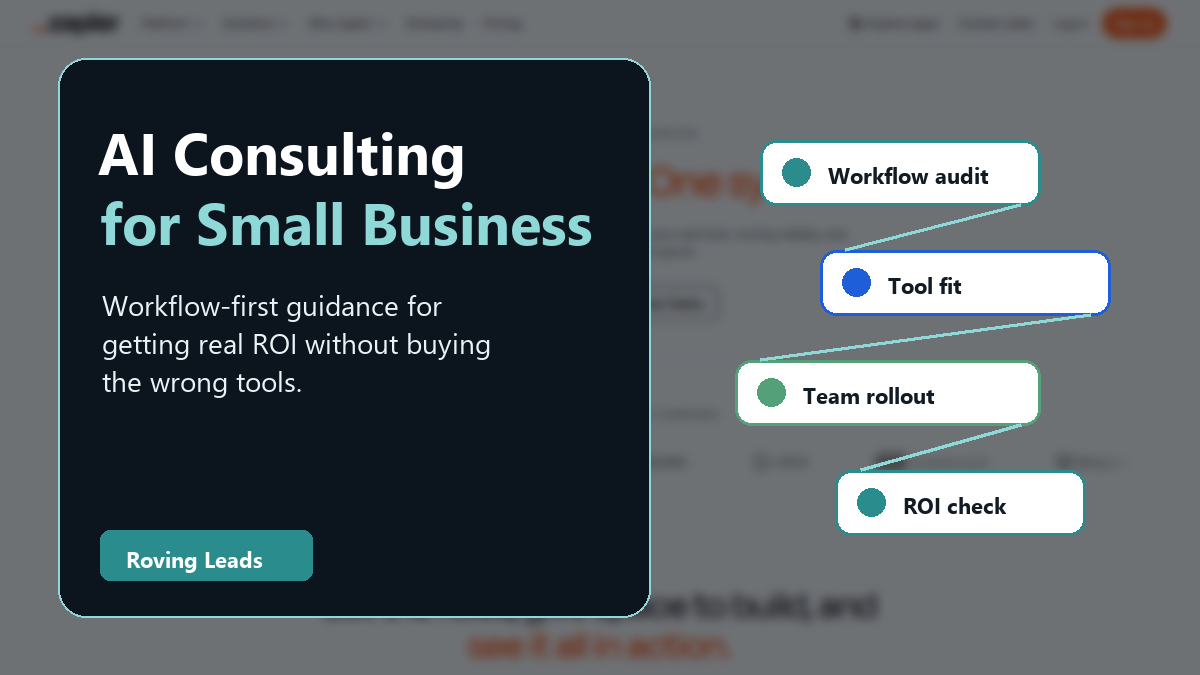
AI Consulting for Small Business is the practice of hiring an expert — or a firm — to help you figure out which AI tools and workflows actually fit your operation, then implementing them in a way that saves time or makes money without creating new headaches.
Most small business owners have tried at least one AI tool by now. But trying ChatGPT for five minutes and getting real results from AI are two very different things. This guide covers what AI Consulting for Small Business actually involves, how to know if you need it, what it costs, and how to avoid the mistakes that waste both time and money.
We work with small businesses across the South Bay — from retail shops in Redondo Beach to service businesses in Torrance — and the same questions come up every time. This article answers them straight.
Key Takeaways
- AI Consulting for Small Business is most valuable when you have a clear, repetitive problem — not when you’re just curious about AI in general.
- The businesses getting real ROI started with one process, not a company-wide overhaul.
- Most small businesses don’t need custom software — they need someone to configure the tools that already exist.
- AI won’t fix a broken process. It’ll make a broken process fail faster and at scale.
- The right consultant doesn’t sell you tools — they help you decide which ones are worth paying for and which ones you can skip.
What AI Consulting for Small Business Actually Means (And What It Doesn’t)

AI Consulting for Small Business is not about building robots or training machine learning models. For 95% of small businesses, it means identifying which tasks in your operation could be handled — fully or partially — by existing AI tools, then setting those tools up to actually work.
A good AI consultant doesn’t walk in with a predetermined solution. They ask questions about your workflows, your bottlenecks, your staff capacity, and your revenue model before recommending anything. That diagnostic step is where most of the value lives.
What it’s NOT: a vendor pitching you software subscriptions you don’t need, a tech agency building a custom app for a problem that a $20/month tool already solves, or a vague strategy session that leaves you more confused than when you started.
Reality Check: If a consultant leads with tool recommendations before understanding your business, walk out. The tool is never the first conversation — the problem is.
The most common deliverables from AI Consulting for Small Business include a process audit, a prioritized list of automation opportunities, tool recommendations with honest cost-benefit breakdowns, and hands-on help implementing the first one or two wins. Some firms also offer AI Staff Training so your team doesn’t sabotage good tools through underuse or misuse.
How to Know If Your Business Is Ready for AI Consulting for Small Business
Not every business needs a consultant. If you have one employee and you love fiddling with new tools, you can probably figure this out yourself with some patience. But if time is your scarcest resource — which it is for most small business owners — getting professional guidance pays for itself quickly.
Here are the clearest signs you’re ready:
– You’re doing the same task manually more than five times a week
– You’ve tried AI tools but can’t get consistent, usable output
– Your team wastes time on admin that pulls them away from revenue-generating work
– You’re worried about falling behind competitors who are moving faster on AI
– You have no idea where to even start evaluating AI tools for your industry
A formal AI Readiness Assessment can answer these questions with specifics rather than guesses. It maps your current state against what’s realistically achievable, so you’re not chasing tools that don’t fit.
68%
of small business owners say they don’t have the knowledge to use AI effectively in their business
That statistic matters because it’s not an indictment of small business owners — it’s an indictment of how AI tools are marketed. They’re sold as plug-and-play when the reality is messier. AI Consulting for Small Business exists to close exactly that gap.
The Highest-ROI Use Cases for AI Consulting for Small Business

Not all AI use cases are equal. Some look impressive in demos and deliver nothing in practice. The ones that consistently produce measurable ROI for small businesses tend to fall into a handful of categories.
Customer Communication and Follow-Up
Responding to leads, sending follow-up emails, handling routine customer questions — this is where small businesses lose the most money through slow response times. AI Consulting for Small Business almost always starts here because the ROI shows up in weeks, not months.
A well-configured AI can draft responses, route inquiries, or trigger follow-up sequences without anyone on your team touching a keyboard. This is why AI Consulting for Small Business often starts with lead response automation. For a service business in Torrance running on a two-person team, that’s a game-changer.
Content and Marketing
AI can write first drafts of emails, social posts, product descriptions, and blog content — but only if you know how to prompt it correctly and review what it produces. Unguided, most businesses either over-rely on raw AI output (and publish garbage) or give up after one bad result.
SEO & Content Management combined with AI tools can significantly reduce the time it takes to maintain a consistent content presence. The key word is “combined.” AI Consulting for Small Business — AI without strategy is just noise.
Scheduling, Admin, and Operations
Appointment booking, invoice follow-ups, internal reporting, data entry — these are pure time sinks. AI tools can handle large portions of these tasks at a fraction of the cost of hiring. For solo operators, this is often the difference between working 60 hours a week and 45. AI Consulting for Small Business helps identify which of these admin tasks to automate first.
Quick Win: Start with one recurring task that takes 3+ hours per week and has clear, consistent inputs. That’s your first automation target — not your most complex problem.
What AI Consulting for Small Business Costs — And What Drives the Price
Pricing for AI Consulting for Small Business varies widely, and that’s not a dodge — it’s because the scope varies widely. Here’s an honest breakdown of what you’ll typically encounter.
The biggest price driver isn’t the number of hours — it’s the complexity of your workflows and how much custom configuration is required. A Redondo Beach restaurant automating reservation reminders is a very different project than a professional services firm automating client intake, billing, and reporting.
Money Leak: Paying for five AI tool subscriptions you’re not using is more expensive than paying a consultant once to tell you which two you actually need. Audit your SaaS stack before you add anything new.
Not sure where AI fits in your business? Our AI Consulting service maps your operations, identifies the highest-ROI opportunities, and gives you a clear action plan. See what’s included ->
How to Choose the Right AI Consulting for Small Business Provider
This market is full of people who learned ChatGPT six months ago and now call themselves AI consultants. Vetting matters more here than in almost any other category of professional services.
Questions to Ask Before Hiring Anyone
These aren’t trick questions — they’re basic due diligence that separates practitioners from people who’ve read a lot of LinkedIn posts about AI:
1. Can you show me a specific example of a workflow you automated for a business similar to mine?
2. What tools do you have financial incentives to recommend, and which ones don’t you?
3. What happens if the implementation doesn’t produce the results you’re projecting?
4. How do you handle AI governance and data privacy for client businesses?
5. Do you offer training for my team, or does everything live in your head?
A consultant who stumbles on any of these questions is telling you something important. Good AI Consulting for Small Business providers have clear answers to all five without hesitation.
Red Flags That Should End the Conversation
Guaranteed ROI promises are a red flag in AI Consulting for Small Business. AI performance depends on your data quality, your team’s adoption rate, and your processes — no honest consultant can guarantee specific numbers upfront. Run from anyone who does.
Also be wary of consultants who can’t explain their recommendations in plain English. If they’re hiding behind jargon, they’re either confused themselves or hoping you won’t ask follow-up questions. Neither is a good sign.
Field Note: We’ve had prospects come to us after paying another consultant $4,000 for a “strategy deck” that recommended tools available on a Google search. Deliverables matter. Ask for them in writing before you sign anything.
AI Consulting for Small Business vs. Doing It Yourself

There’s a real argument for DIY — especially if you’re a solopreneur with time to experiment, a modest budget, and genuine curiosity about how these tools work. We offer Solopreneur AI Coaching specifically for people in that category who want guidance without a full engagement.
But DIY has real costs that are easy to undercount. AI Consulting for Small Business exists because those costs are often invisible until they’ve already been paid. The hours spent testing tools that don’t work, the opportunity cost of slow implementation, the mistakes that create data problems or customer experience issues downstream — these add up fast. For a business owner billing $150/hour in their own right, three months of trial and error could cost more than a solid consulting engagement.
“Small businesses that work with outside advisors grow 4x faster and have higher revenue growth rates than those that don’t seek outside help.” — Small Business Administration, SBA Business Guide
The DIY vs. hire decision really comes down to this: how much is your time worth, and how much runway do you have to figure it out? If the answer is “my time is expensive and I need results in 90 days,” hire a professional. If the answer is “I have six months and I genuinely enjoy this stuff,” start with 1-on-1 AI Coaching and build your own capability.
Protecting Your Business: AI Governance and Risk Management

This is the part of AI Consulting for Small Business that most businesses skip — and then regret. AI tools process data. Sometimes that data includes customer information, financial records, or proprietary business processes. If you don’t have policies governing how your team uses AI, you’re exposed.
Any good AI Consulting for Small Business engagement includes governance basics. AI governance for small businesses doesn’t need to be a 50-page legal document. It needs to answer four questions clearly:
– What data are employees allowed to input into AI tools?
– Which AI tools are approved for business use, and which aren’t?
– Who is responsible for reviewing AI-generated output before it reaches customers?
– What happens when something goes wrong?
Owner Decision: Before you deploy any AI tool that touches customer data, get a basic policy document in place. It doesn’t have to be long — it has to be clear. AI Governance Documents are something we build specifically for small businesses at a price point that makes sense.
The McKinsey State of AI report consistently shows that businesses with formal AI governance protocols report fewer implementation failures and better ROI. For large enterprises, that means legal teams and compliance officers. For small businesses, it means a one-page policy and a monthly check-in.
What a Real AI Consulting for Small Business Engagement Looks Like
Let’s make this concrete. Here’s what a typical engagement with a small business looks like from start to finish — no fluff.
Week 1-2: Discovery
The consultant interviews the owner and any key team members, reviews current tools and workflows, and identifies where time and money are leaking. This is the foundation. Skip it and everything downstream is guesswork.
Week 3: Prioritization
Not everything can be automated, and not everything should be. A good consultant ranks opportunities by impact and implementation difficulty, then recommends starting with the highest-impact, lowest-complexity options. For a service business in the South Bay, that might mean starting with AI-assisted appointment reminders before touching anything more complex.
Weeks 4-8: Implementation
This is where tools get configured, tested, and handed off. It includes documentation so your team knows how to use what was built — because AI Staff Training is not optional. Tools that don’t get used don’t produce ROI.
Ongoing: Governance and Iteration
Good implementations get reviewed, refined, and extended over time. The best AI Consulting for Small Business relationships are ongoing, not one-and-done. Custom AI Agents may be added later as your processes become more sophisticated. The first engagement is rarely the last conversation.
Tool Pick: For most small businesses starting out, a combination of ChatGPT (or Claude), Zapier or Make for automation, and your existing CRM handles 80% of the most valuable use cases. You don’t need exotic tools — you need the right configuration and prompting strategy.
FAQ — AI Consulting for Small Business
How much does AI Consulting for Small Business typically cost?
Expect to pay $500-$1,500 for a standalone readiness assessment, $2,000-$8,000 for a full consulting engagement, and $150-$300 per session for ongoing coaching. Pricing depends on scope, business complexity, and how much implementation support you need. Avoid anyone who quotes a price before understanding your business — that’s a sign they’re selling a package, not a solution.
What’s the difference between an AI consultant and a software vendor?
A software vendor sells you their tool. An AI consultant is supposed to be tool-agnostic — they recommend whatever fits your situation, even if that means recommending something they don’t sell. Ask any consultant upfront whether they receive commissions or referral fees from any of the tools they recommend. The honest ones will tell you clearly. If they dodge the question, that’s your answer.
How long does it take to see results from AI Consulting for Small Business?
For well-scoped, straightforward projects — like automating appointment reminders or setting up AI-assisted email drafts — you can see measurable time savings within 30 days. More complex implementations, like integrating AI across multiple departments or building custom workflows, typically take 60-90 days before results are clear. Anyone promising results faster than that without knowing your business is overselling.
Do I need to be tech-savvy to work with an AI consultant?
No. A good consultant translates technical concepts into plain English and builds systems your team can actually use. If you’re walking out of meetings confused, that’s a consultant problem, not a you problem. You should understand exactly what was built, why it was built that way, and how to maintain it — without needing a computer science degree.
Can AI really help a small business compete with larger companies?
Yes — and this is one area where small businesses have a genuine structural advantage. Large companies have legacy systems, slow approval processes, and change management nightmares. A small business can implement an AI workflow in two weeks that a large enterprise would spend six months debating. The speed advantage is real, but only if you actually move.
What should I have ready before my first AI consulting session?
Come with a list of the five tasks that eat the most time in your week, a rough sense of your current tool stack (what software you’re already paying for), and one or two processes that have clear, repeatable steps. You don’t need anything polished. The consultant’s job is to help you see structure in what feels like chaos — but knowing your own pain points saves everyone time.
Bottom Line
AI Consulting for Small Business is worth it when you have a real problem, a willingness to change how your team works, and a consultant who starts with your business rather than their favorite tool. It is not worth it if you’re chasing novelty, expecting overnight results, or hoping AI will fix processes that are broken for reasons that have nothing to do with technology. The businesses getting real ROI from AI aren’t the ones with the most sophisticated tools — they’re the ones who started with the right problem and stayed disciplined about implementation. Pick one process, fix it properly, and build from there.
Ready to Stop Guessing and Start Getting Results?
Getting started with AI Consulting for Small Business doesn’t have to be complicated — but it does have to be deliberate. If you’re a small business owner in Redondo Beach, Torrance, or anywhere in the South Bay, we’re here to help you figure out where AI actually fits — and where it doesn’t. Start with our AI Readiness Assessment if you want a structured starting point, or reach out directly if you’d rather just talk it through. Either way, the goal is the same: real ROI, not impressive demos.
What’s the one process in your business that eats the most time? We’d love to hear — drop a comment below.
Want to talk this through with someone who’s done it?