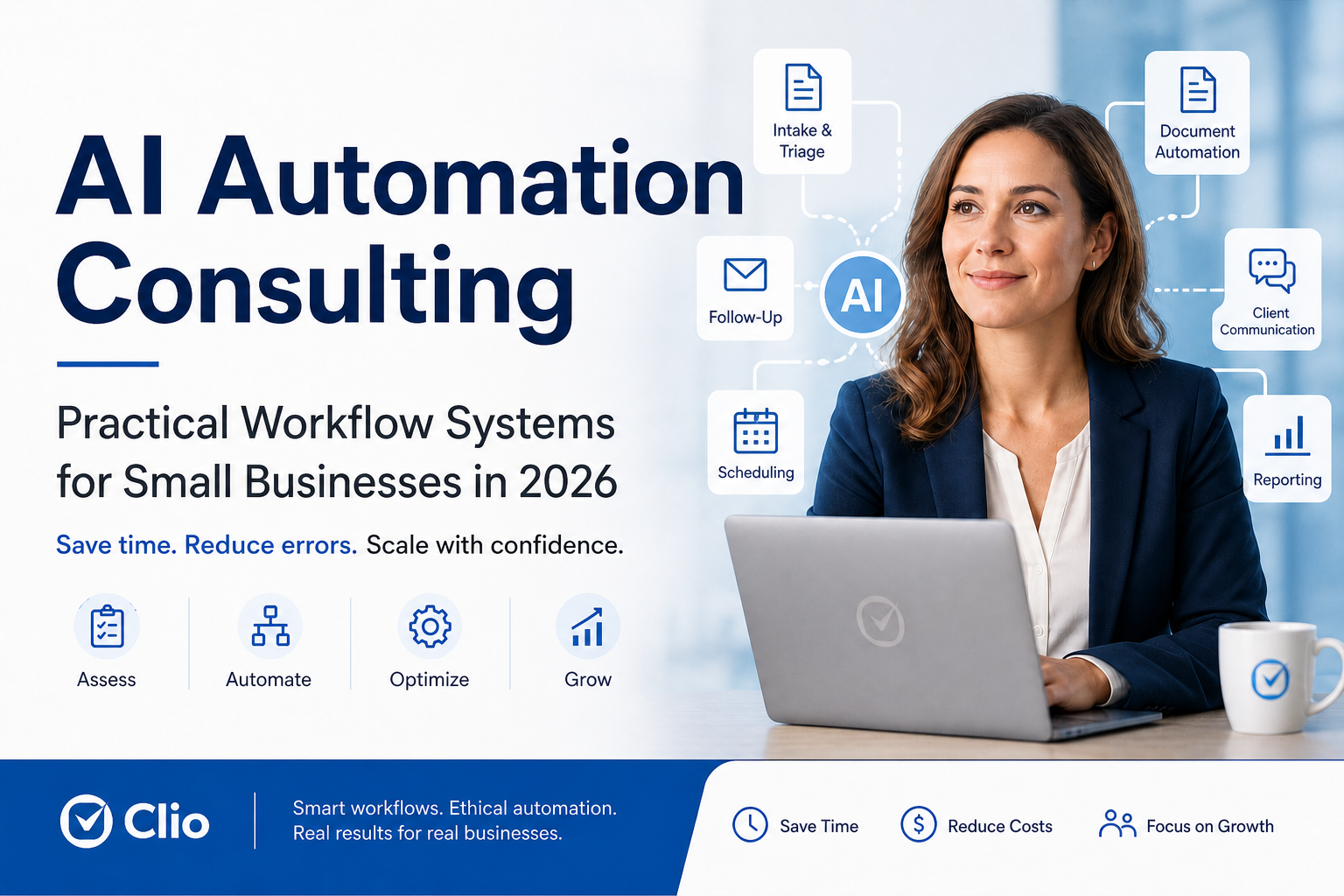
AI Automation Consulting is the practice of auditing how a business actually operates, identifying where intelligent automation can reduce manual work or improve consistency, and then designing, building, and monitoring the systems that make that happen. It is not a software demo. It is not a list of apps to subscribe to. It is an operating model conversation that ends with working systems your team can use and trust.
For small business owners in the South Bay and greater Los Angeles area, that distinction matters enormously right now. AI tools are everywhere. Figuring out which ones belong in your business—and how to connect them into something that actually saves time—is a different problem entirely. That is the problem AI Automation Consulting is designed to solve.
If you are just getting oriented, the AI Automation for Small Businesses guide is a solid starting point before you engage any consultant. This article goes deeper: what a real engagement covers, what it should cost you in time and attention, and how to tell a good consulting partner from a vendor in disguise.
🔑 Key Takeaways
- AI Automation Consulting is about workflow design and operating model decisions, not tool selection alone.
- The audit comes before the automation—any consultant who skips this step is selling, not consulting.
- Small businesses in 2026 need implementation support, not just another subscription. Goldman Sachs research confirms that training and support gaps are the primary barrier to AI ROI.
- Risk management—privacy, accuracy, and documentation—is a core deliverable, not an afterthought.
- The right AI Automation Consulting partner starts with your workflows, not their preferred software stack.
- Payoff usually appears first in lead follow-up, client communication, scheduling, and content operations.
Table of Contents
What AI Automation Consulting Actually Covers
The phrase gets used loosely, so it helps to be precise. AI Automation Consulting sits at the intersection of process improvement, technology integration, and change management. A consultant in this space is not primarily a software trainer. They are someone who maps how work flows through your business today and redesigns that flow so that intelligent systems handle the repeatable parts.
That redesign work is more consequential than it sounds. Microsoft’s 2026 Work Trend Index frames the current shift not as individual workers adopting chat tools, but as organizations moving toward human-agent teams with deliberately designed handoffs. For a small business, that means your consultant should be thinking about where a human decision is required, where an agent can act autonomously, and how those two modes connect cleanly.
AI Automation Consulting typically covers some combination of the following areas, depending on business size and maturity:
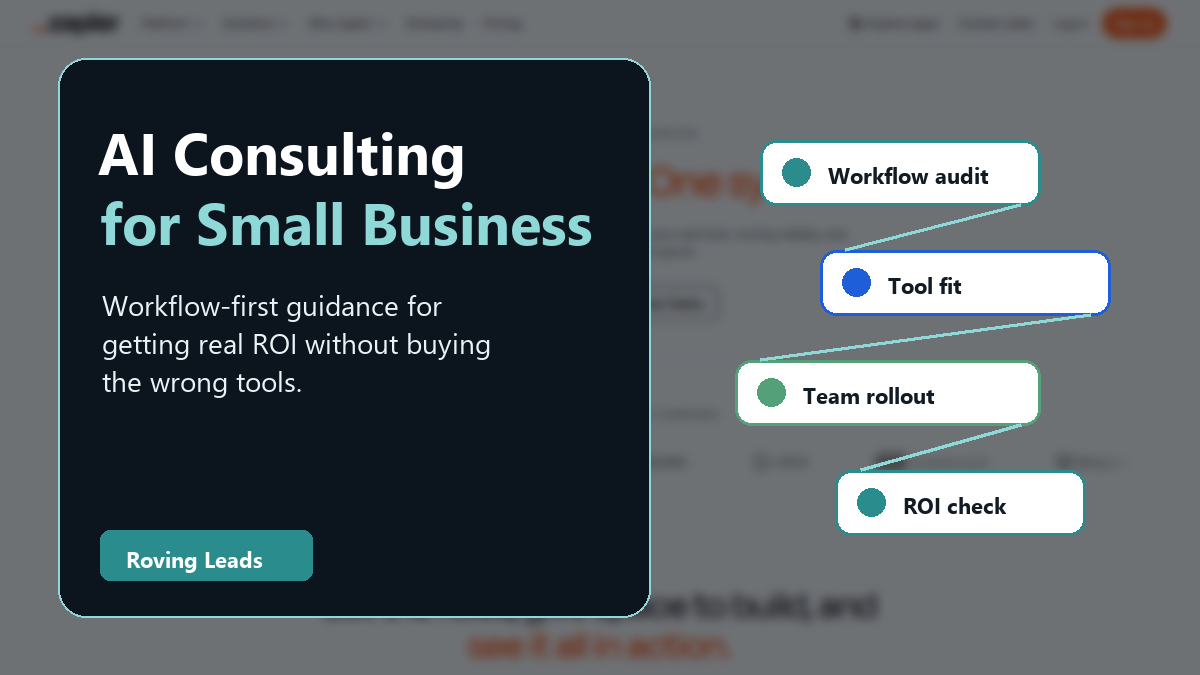
- Workflow mapping and gap analysis — documenting current processes and identifying friction points where automation would have the highest leverage.
- Automation architecture — deciding which tasks are appropriate for AI agents, which need human review, and how data moves between systems.
- Build and integration — configuring or building the actual automations, connecting them to your existing tools, and testing them under real conditions.
- Risk and governance setup — establishing policies, review gates, and documentation so the business stays compliant and the systems stay accurate.
- Team training and rollout — making sure your staff can operate, override, and improve the systems without depending on the consultant indefinitely.
- Monitoring and iteration — setting up the feedback loops that catch errors and surface improvement opportunities over time.
Notice that “pick the right AI tool” is not the top of that list. It is embedded inside architecture and build. A good AI Automation Consulting engagement starts with your business, not with a vendor’s feature sheet.
💡 Callout: If a consultant’s first question is “what tools are you currently using?” instead of “walk me through how a new lead becomes a paying client,” that is a signal they are optimizing for a tool sale, not a workflow improvement.
The scope of AI Automation Consulting also varies by business stage. A solopreneur running a service business has different needs than a 12-person team with multiple departments. Both benefit from the consulting model, but the deliverables look different. That is why an AI Readiness Assessment is often the right first step—it calibrates the engagement to where you actually are, not where a generic playbook assumes you are.

When A Small Business Needs AI Automation Consulting
Not every business needs a full AI Automation Consulting engagement on day one. But there are clear signals that you have moved past the “experiment with a chatbot” stage and into territory where structured consulting pays off.
The most common trigger is time: you or your team are spending significant hours each week on tasks that feel mechanical—sending follow-up emails, copying data between systems, formatting reports, answering the same questions repeatedly. When that pattern is consistent and the volume is high enough to hurt, AI Automation Consulting can reclaim those hours and redirect them toward work that actually requires a human.
The second trigger is inconsistency. If your client experience varies depending on who is working that day, or if things fall through the cracks when you are busy, automation can enforce the standard. AI Automation Consulting helps you bake your best process into a system instead of relying on memory and goodwill.
The third trigger is growth friction. Many South Bay small businesses hit a ceiling where they cannot take on more clients without hiring, but the revenue does not yet justify the headcount. AI Automation Consulting is often the bridge—it creates capacity without proportional cost.
“Small businesses are embracing AI but still need training and support to fully harness it.” — Goldman Sachs, 2026
That Goldman Sachs finding is worth sitting with. The barrier for most small businesses is not access to AI tools—it is the implementation gap. Owners subscribe to software, use 20% of its capability, and then blame AI when results are underwhelming. AI Automation Consulting closes that gap by providing the structured support that turns a tool subscription into a functioning system.
You probably do not need AI Automation Consulting yet if your processes are not documented, your team is fewer than two people and still figuring out the basics, or you are not sure what problem you are trying to solve. In those cases, a lighter-touch option like Solopreneur AI Coaching may be a better fit to get oriented before committing to a larger engagement.
For businesses that are ready, the payoff from AI Automation Consulting compounds. Systems built well in the first engagement become the foundation for more sophisticated automation later. The businesses that invest early tend to pull ahead of competitors who are still doing things manually.
The Workflow Audit Comes Before The Automation
This is the part of AI Automation Consulting that separates real practitioners from people who are essentially reselling software. Before a single automation is built, a competent consultant needs to understand how your business actually operates—not how you think it operates, and not how the org chart says it should.
The workflow audit is a structured discovery process. It typically involves interviews with the owner and key staff, observation of actual workflows in action, documentation of inputs, outputs, handoffs, and decision points, and identification of where time is lost, errors occur, or the experience degrades.
What comes out of a good audit is a prioritized map: here are the ten things that could be automated, here are the three that will have the highest impact, and here is the order in which to tackle them. That map is the foundation of the entire AI Automation Consulting engagement. Without it, you are guessing.

The audit also surfaces the constraints that shape what automation is actually feasible. Data quality issues, legacy software that does not integrate cleanly, staff capacity for change, and compliance requirements all affect what a consultant can responsibly recommend. Skipping the audit means those constraints show up as problems mid-build, which is expensive and disruptive.
📋 Callout: A workflow audit is not a sales call. It should produce a document you could hand to any competent consultant and get a similar diagnosis. If the audit output only makes sense inside that consultant’s proprietary system, ask why.
For businesses that want to do some of this work themselves before engaging a consultant, the South Bay Small-Business AI Starter Kit includes a self-guided workflow review that helps you identify your highest-leverage automation candidates. It is not a substitute for a professional audit, but it gets you to the first conversation with a much clearer picture of your own operations.
One more thing the audit does: it establishes a baseline. You cannot measure the ROI of AI Automation Consulting if you do not know what you were spending before. Time per task, error rates, follow-up lag, client satisfaction scores—whatever matters in your business, the audit captures it so you have something to compare against after implementation.
What A Practical AI Automation Engagement Looks Like
AI Automation Consulting engagements vary in length and scope, but a well-structured one tends to follow a recognizable arc. Here is what a practical engagement looks like for a South Bay small business with five to fifteen employees.
| Phase | What Happens | Owner Time Required | Typical Duration |
|---|---|---|---|
| Discovery & Audit | Workflow mapping, interviews, baseline documentation | 4–8 hours | 1–2 weeks |
| Strategy & Architecture | Prioritized automation roadmap, system design, risk review | 2–4 hours | 1 week |
| Build & Integration | Automations configured, connected, and tested | 2–3 hours (review & approval) | 2–4 weeks |
| Training & Handoff | Staff trained, documentation delivered, override procedures set | 3–5 hours (team) | 1 week |
| Monitoring & Iteration | Performance review, error catches, refinement cycles | 1–2 hours/month | Ongoing |
The total owner time commitment for the first phase of a well-run AI Automation Consulting engagement is typically ten to twenty hours spread over six to eight weeks. That is not trivial, but it is far less than the ongoing manual labor the systems replace.
The build phase is where the Custom AI Workflow Systems work happens—configuring agents, connecting APIs, writing the logic that governs how the automation behaves, and testing edge cases. This is technical work, but the consultant should be translating it into plain language at every review checkpoint so you understand what is running in your business.
Training is not optional. A system your team does not understand is a liability. Good AI Automation Consulting includes structured Team Training and AI Workflow Rollout so that your staff can operate the systems confidently, know when to override them, and can flag problems without needing to call the consultant every time something unexpected happens.
The monitoring phase is what separates a real AI Automation Consulting engagement from a one-time project. AI systems drift. Inputs change. Business conditions shift. A consultant who hands off and disappears has not actually solved your problem—they have created a new dependency. The best engagements include a defined monitoring cadence and clear criteria for when a human needs to intervene.

Where AI Automation Consulting Usually Pays Off First
Every business is different, but AI Automation Consulting tends to deliver the fastest, most measurable ROI in a handful of recurring areas. These are not the only places automation creates value—they are just where the friction is usually highest and the automation is most straightforward to implement.
Lead follow-up and nurture. This is the single most common high-value target in AI Automation Consulting engagements with South Bay service businesses. Leads come in, get a manual response hours or days later, and convert at a fraction of what they could. Automated follow-up sequences—triggered immediately, personalized by lead source and inquiry type, and escalated to a human when the conversation gets complex—routinely double or triple contact rates. For more on this in a specific context, the AI Automation for Real Estate Agents guide shows how the same pattern applies in a high-volume lead environment.
Client onboarding and intake. The first week of a client relationship sets the tone for everything that follows. AI Automation Consulting can systematize the intake form, the welcome sequence, the document collection, the kickoff scheduling, and the internal handoff—so every new client gets the same excellent first experience regardless of how busy the team is.
Appointment scheduling and reminders. Manual scheduling is a time sink that compounds across dozens of clients. Automated scheduling, confirmation, and reminder sequences reduce no-shows, eliminate back-and-forth email chains, and free up the hours your front office spends on calendar management.
Content and communication operations. For businesses that rely on regular content—newsletters, social posts, review requests, service updates—AI Automation Consulting can build the pipeline that drafts, schedules, and distributes content consistently. This pairs naturally with ongoing SEO and Content Management work when the content strategy is already in place.
Internal reporting and data aggregation. Many small business owners spend hours each week pulling numbers from different systems and assembling them into a picture of how the business is doing. Automation can handle the aggregation and formatting, delivering a clean dashboard or report on a schedule so the owner can spend that time acting on the data instead of collecting it.
“The businesses that get the most from AI Automation Consulting are not the ones with the most sophisticated tech stacks. They are the ones with the clearest picture of where their time actually goes.”
It is also worth noting what AI Automation Consulting does not fix quickly: broken sales processes, unclear value propositions, or team culture problems. Automation amplifies what is already there. If the underlying process is broken, automating it makes it break faster and at scale. This is another reason the audit phase is non-negotiable.
Risks A Good Consultant Should Control
AI Automation Consulting done well is not just about building things that work—it is about building things that work safely, consistently, and in a way the business can stand behind. Risk management is a core deliverable, not a footnote.
The NIST AI Risk Management Framework organizes this work into four functions: Govern, Map, Measure, and Manage. For small businesses, that translates into practical questions your consultant should be answering throughout the engagement.
Govern: Who is accountable for each automated system? What policies govern how AI can and cannot be used in your business? What happens when a system produces an error that reaches a client? These questions need answers before anything goes live, not after the first incident. AI Governance Documents formalize these answers into a reference your team can actually use.
Map: Where does AI touch your data, your clients, and your operations? A competent AI Automation Consulting engagement produces a clear map of every point where an automated system makes a decision or sends a communication. That map is essential for compliance, for debugging, and for explaining your systems to clients who ask.
Measure: How do you know the automation is performing correctly? Accuracy rates, error logs, client complaint patterns, and output quality checks are all measurement mechanisms a good consultant builds into the system from the start. Measurement is what turns a one-time build into a system that improves over time.
Manage: What is the response plan when something goes wrong? Every AI system will eventually produce an output that is wrong, inappropriate, or outdated. A good AI Automation Consulting engagement includes defined escalation paths, override procedures, and rollback capabilities so that a problem is contained quickly and does not compound.
⚠️ Risk Callout: Privacy is a non-negotiable. Any AI system that processes client data—names, contact information, purchase history, health information—must be built with data handling policies that comply with applicable law. A consultant who does not raise this topic in the first conversation is not thinking about your liability.
For California businesses, this is especially relevant. State privacy law creates real obligations around how personal data is collected, processed, and stored. AI Automation Consulting that touches client data needs to account for these requirements at the architecture stage, not as a retrofit.
The risk conversation is also where AI Automation Consulting earns its fee most clearly. A poorly governed automation that sends incorrect information to clients, exposes private data, or makes decisions without appropriate human review can cost far more to remediate than the entire consulting engagement. Getting this right upfront is not conservative—it is smart business.

How To Choose The Right AI Automation Consulting Partner
The AI Automation Consulting market in 2026 is crowded and uneven. There are excellent practitioners, generalist agencies that have added “AI” to their service list, and software vendors who call their onboarding team a consulting practice. Knowing how to tell them apart will save you significant time and money.
Start with the questions they ask, not the answers they give. A consultant who leads with their tool stack or their case study deck before asking about your business is optimizing for their pitch, not your outcome. The first substantive conversation with a good AI Automation Consulting partner should feel like a diagnostic, not a sales presentation.
Ask to see their audit process. What does the workflow discovery look like? What do they deliver at the end of it? If the answer is vague or proprietary in a way that prevents you from taking that work elsewhere, that is a red flag. A real AI Automation Consulting engagement produces documentation that belongs to you.
Ask about governance and risk. A consultant who does not have a clear answer about how they handle data privacy, error management, and client-facing AI communications has not thought carefully enough about the systems they are building. This is especially important for businesses in regulated industries or those handling sensitive client information.
Ask about training and handoff. What does the engagement look like after the build is done? If the answer is “we monitor it for you indefinitely,” ask what happens if you want to bring that capability in-house. If the answer is “we hand it off and you are on your own,” ask what support looks like when something breaks. Neither extreme is ideal. Good AI Automation Consulting builds toward your independence while providing a safety net during the transition.
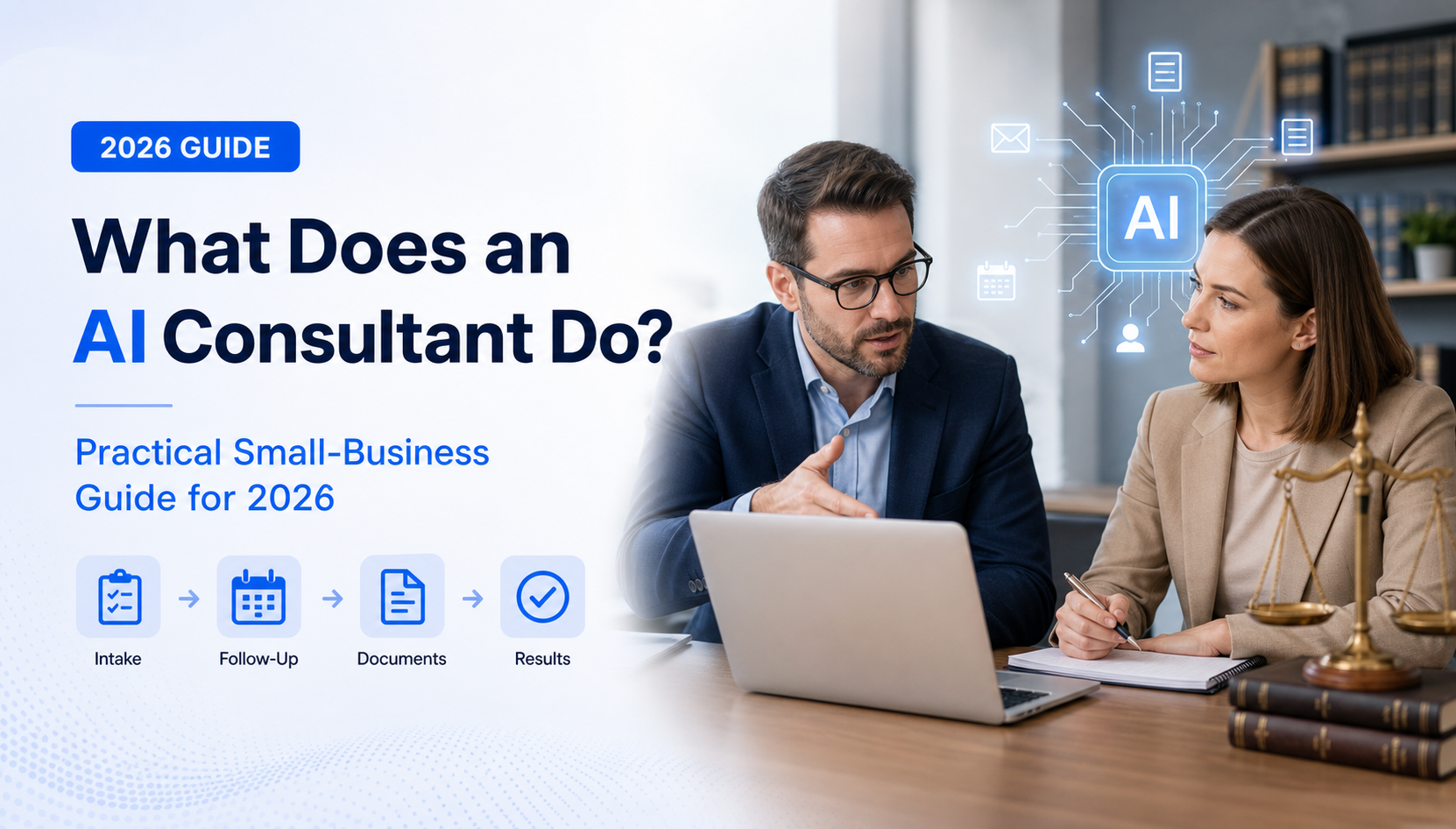
Look for demonstrated experience with businesses similar to yours. AI Automation Consulting for a restaurant has different priorities than AI Automation Consulting for a law firm or a real estate team. The AI Automation for Restaurants guide and the What Does an AI Consultant Do guide both illustrate how context shapes the consulting approach. A partner who has worked in your sector will ask better questions and make fewer costly assumptions.
Finally, check whether they are willing to start small. A reputable AI Automation Consulting partner will often recommend a scoped first engagement—an audit, a single workflow build, a readiness assessment—before committing to a large retainer. That sequencing protects you and demonstrates that the consultant is confident enough in their work to let results speak before asking for a long-term commitment.
If you are ready to explore what AI Automation Consulting could look like for your specific business, the best next step is a direct conversation. You can reach out here to talk through where you are and what a practical engagement might cover.
The South Bay Small-Business AI Starter Kit.
28 pages. Three free quick wins, five revenue areas, a self-assessment, and a simple roadmap for South Bay businesses trying to understand where AI actually makes money.
 PDF
PDF
FAQ — AI Automation Consulting
How much does AI Automation Consulting typically cost for a small business?
Cost varies significantly based on scope, business complexity, and the consultant’s model. A focused engagement—audit plus one or two workflow builds—typically runs from a few thousand dollars to around ten thousand dollars for a small business. Larger engagements with multiple departments, custom integrations, and ongoing monitoring can run higher. The more useful question is ROI: if AI Automation Consulting reclaims ten hours per week of staff time, what is that worth to your business annually? Most well-scoped engagements pay for themselves within two to four months.
How is AI Automation Consulting different from hiring a virtual assistant or a software vendor?
A virtual assistant handles tasks manually. A software vendor sells you a tool and expects you to figure out how to use it. AI Automation Consulting designs the system that sits between your business and the tools—the logic, the handoffs, the governance, and the training that makes automation actually work. The consultant’s job is to make your business more capable, not to create a dependency on their services or their preferred software. That is a fundamentally different relationship than either of the alternatives.
Do I need to have existing AI tools in place before starting an AI Automation Consulting engagement?
No. In fact, coming in without strong tool commitments gives a good consultant more flexibility to recommend the right architecture for your specific needs. If you already have tools in place, a competent AI Automation Consulting partner will work with what you have where possible and flag where a change would meaningfully improve outcomes. What you do need before starting is a reasonably clear picture of your core workflows and a willingness to document how work actually gets done—not how you think it should get done.
How long before I see results from AI Automation Consulting?
For straightforward workflow automations—lead follow-up sequences, scheduling, intake forms—results are often visible within the first two to four weeks after go-live. More complex builds with multiple integrations or significant change management requirements may take six to ten weeks before the system is running smoothly enough to measure clearly. The audit and strategy phases do not produce visible results on their own, but they are what make the build phase produce durable results instead of fragile ones. Patience during discovery pays off in the implementation.
What should I prepare before my first AI Automation Consulting conversation?
Three things will make that first conversation significantly more productive. First, a rough sense of where your team’s time goes each week—even an informal breakdown by category is helpful. Second, a description of your most frustrating recurring process: the thing that takes too long, happens inconsistently, or falls through the cracks most often. Third, any existing documentation you have about your workflows, even if it is incomplete. You do not need to have everything figured out—that is what the audit is for. But coming in with those three things signals to the consultant that you are ready to do the work, and it helps them give you a more accurate scope and timeline from the start.
🏁 Bottom Line
AI Automation Consulting in 2026 is not about adopting the latest tools—it is about redesigning how your business operates so that intelligent systems handle the repeatable work and your team focuses on what actually requires human judgment. The businesses that get this right are building durable competitive advantages. The ones that skip the audit, skip the governance, or treat automation as a one-time project are creating technical debt they will pay for later.
If you are a South Bay small business owner evaluating whether AI Automation Consulting is the right next step, start with an honest look at where your time goes and where your processes break down. The answers to those two questions will tell you more than any vendor demo. When you are ready to go deeper, reach out for a direct conversation—no pitch deck required.
AI Automation Consulting is a practical discipline, not a futuristic one. The businesses benefiting from it right now are not the largest or most technically sophisticated—they are the ones that took the time to understand their own workflows and found a consulting partner who started there too. That combination of self-knowledge and structured support is what turns AI from a subscription into a system that actually works.