
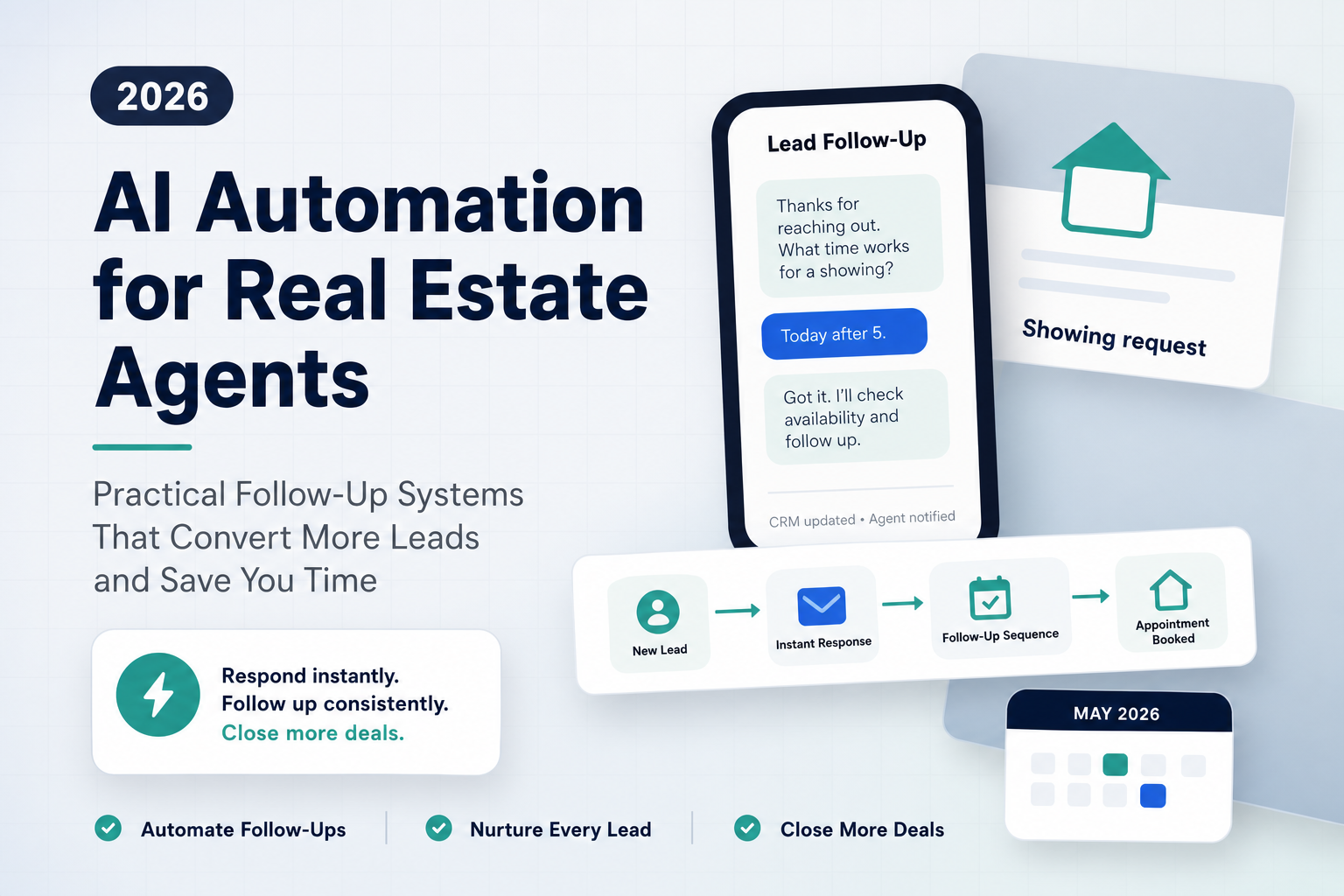
AI Automation for Real Estate Agents is the fastest way a solo agent or small team can stop losing deals to slow follow-up — without hiring another assistant or paying for another lead source. The problem is not usually where your leads come from. The problem is what happens in the first five minutes after they arrive.
This article is a practical system guide, not a product list. If you are a solo agent, a two-person team, or a small brokerage in a competitive local market, you will find specific workflows here that you can build, test, and run — covering buyer inquiries, seller nurture, open house follow-up, showing requests, review collection, and compliance guardrails. AI Automation for Small Businesses covers the broader framework; this guide goes deep on the real estate use case specifically.
The goal is a follow-up system that works while you are in a showing, on a listing appointment, or off the clock — one that sounds like you, not like a chatbot from 2019.
Key Takeaways
- Speed is the real problem. Conversion rates are 8× higher when a lead gets a response within five minutes. Most agents cannot do that manually, every time, for every lead.
- The core system comes first. Before buying more leads, you need an instant response system, a CRM that is actually clean, and a follow-up sequence that runs without you.
- Buyer and seller workflows are different. Buyer leads need speed and qualification. Seller leads need patience, consistency, and a nurture sequence that can run for 12–18 months.
- Open house leads are the most wasted leads in real estate. A showing follow-up sequence built on AI Automation for Real Estate Agents can recover a significant portion of those conversations.
- Compliance is not optional. Fair housing rules apply to automated messaging and AI-generated content. Every workflow needs a human review step and documented guardrails.
Why Real Estate Follow-Up Is the Best First Automation Target
AI Automation for Real Estate Agents works best when it is applied to a problem that is both high-frequency and high-stakes. Follow-up is exactly that. Every day, agents receive inquiries from Zillow, Realtor.com, their own website, open house sign-in sheets, and referrals — and a significant portion of those leads go cold before the agent ever responds.
According to lead response management research, conversion rates are 8× higher when a lead is contacted within five minutes of inquiry. In the same dataset, 77% of leads received no response at all. That is not a lead generation problem. That is a follow-up infrastructure problem.

The NAR lead generation data shows that social media (39%), CRM (23%), and local MLS (17%) are the top sources of quality leads. Notice what that list tells you: the leads are already coming from channels you have. The gap is not sourcing — it is what happens after the lead arrives.
AI Automation for Real Estate Agents targets that gap directly. An instant response system handles the first contact. A qualification sequence gathers basic information. A CRM that is actually maintained routes the lead to the right follow-up track. None of that requires you to be sitting at your desk at 9 PM when a buyer submits a showing request.
Why this matters for South Bay agents specifically: Markets like Torrance, Redondo Beach, and Manhattan Beach move fast. A buyer who submits an inquiry on a Thursday evening and does not hear back until Friday afternoon has already toured with another agent. AI consulting in Torrance and surrounding South Bay communities increasingly focuses on this exact problem — response speed in competitive inventory environments.
The NAR 2025 Technology Survey found that 82% of clients responded positively or very positively to tech use in the buying and selling process. Clients are not afraid of automation. They are frustrated by silence.

“The leads are already coming from channels you have. The gap is not sourcing — it is what happens after the lead arrives.”
The Core System Agents Need Before Buying More Leads
Before any agent invests in AI Automation for Real Estate Agents at a sophisticated level, there is a foundational layer that has to exist. Most agents skip it and go straight to buying tools. That is why their automation does not work — the pipes are broken before the water even flows.
The core system has four components. Build these first.
- An instant response system. When a lead comes in from any source — your website, a portal, a text, a form — something needs to respond within minutes, not hours. This is typically a combination of a voice agent or SMS bot that acknowledges the inquiry, confirms receipt, and asks one qualifying question. It does not need to be complex. It needs to be fast and consistent.
- A clean, maintained CRM. AI Automation for Real Estate Agents cannot function on top of a CRM full of duplicates, dead leads, and missing contact fields. Before you automate follow-up, you need a CRM cleanup pass. That means deduplicating contacts, tagging leads by source and status, and setting up basic pipeline stages. This is not glamorous work, but it is the foundation everything else runs on.
- A follow-up sequence by lead type. Buyer leads, seller leads, open house leads, and past clients all need different sequences. A buyer who just submitted a showing request needs a response in minutes and a qualification call within the hour. A seller who downloaded your home valuation guide needs a 12-touch nurture sequence over six months. Treating them the same way is why most follow-up fails.
- A human review checkpoint. Every automated workflow needs at least one point where a human — you or a team member — reviews what went out and confirms the lead is being handled correctly. AI Automation for Real Estate Agents is not a set-it-and-forget-it system. It is a system that handles the volume so you can focus on the conversations that actually close.
If you are not sure whether your current setup is ready for automation, an AI Readiness Assessment can help you identify exactly where the gaps are before you invest in building anything new.
| Automation Area | Response Speed Goal | AI Role | Human Role | Risk Level |
|---|---|---|---|---|
| Buyer Inquiry Response | Under 5 minutes | Instant acknowledgment, qualification questions | Follow-up call, showing booking | Medium |
| Seller Nurture | First touch same day | Long-sequence email/SMS, market updates | Listing appointment, pricing conversation | Medium-High |
| Open House Follow-Up | Within 2 hours of event | Thank-you sequence, interest survey | Hot-lead call, showing scheduling | Low-Medium |
| Showing Request | Immediate confirmation | Booking confirmation, reminder sequence | Showing, post-showing debrief | Low |
| Review Request | Within 48 hours of close | Automated request, reminder follow-up | Personal thank-you, referral ask | Low |
| Compliance Review | Before any content goes live | Draft generation, flagging | Final review, approval, publishing | High |
Buyer Lead Automation Without Sounding Robotic
The biggest fear agents have about AI Automation for Real Estate Agents is that their follow-up will sound like a form letter. That fear is valid — but it is a design problem, not an automation problem. A poorly written sequence sounds robotic whether a human sends it or a system does.
Good buyer lead automation starts with voice and tone. Write your sequences the way you actually talk. Use the buyer’s name. Reference the specific property or neighborhood they asked about. Ask one question per message, not five. These are not AI tricks — they are basic communication principles that automation makes consistent.

Here is what a functional buyer lead sequence looks like in practice for AI Automation for Real Estate Agents:
Minute 0–5: An instant response system sends a text or email acknowledging the inquiry. It confirms you received their request and asks one qualifying question — typically timeline or financing status. This is not a sales pitch. It is a handshake.
Hour 1: If the lead has not responded, a second touch goes out — slightly different wording, same tone. If they have responded, the system routes them to a “warm lead” track and flags them for a personal call from you.
Day 2–3: A follow-up message references the original property or search area and offers something useful — a neighborhood guide, a list of comparable recent sales, or a simple question about what they are looking for. The goal is to stay relevant, not to push.
Day 7 and beyond: Leads who have not converted to a showing get moved to a longer nurture track. This is where AI Automation for Real Estate Agents earns its keep — maintaining contact with 40 or 50 leads simultaneously, each at their own pace, without you manually tracking every one.
The research from the lead response management study also found that making seven or more contact attempts yields 15% more connections than stopping at two or three. Most agents give up after one or two touches. Automation makes persistence possible without making it feel desperate.
One important note on qualification: AI Automation for Real Estate Agents can gather basic information — timeline, financing, property type — but it should not make assumptions about a buyer’s financial situation or push toward a specific price range based on demographic signals. That is where fair housing risk begins. Keep qualification questions factual and open-ended.
Seller Nurture Automation for Long, Uneven Timelines
Seller leads are fundamentally different from buyer leads, and AI Automation for Real Estate Agents has to treat them that way. A buyer who submits a showing request is usually ready to act within days or weeks. A seller who downloads a home valuation report might be 14 months away from listing. The nurture timeline is long, the touchpoints need to be genuinely useful, and the sequence cannot feel like a drip campaign from 2015.
The NAR/RPR 2026 AI survey found that 71% of agents cite saving time as the top value of AI — and seller nurture is exactly where that time savings compounds. Staying in consistent contact with 30 potential sellers over 12 months is nearly impossible to do manually without something slipping. A well-built seller nurture workflow handles the consistency so you can focus on the conversations that actually move toward a listing appointment.
A practical seller nurture workflow for AI Automation for Real Estate Agents looks like this:
Month 1: A welcome sequence that delivers on whatever they opted in for — a valuation, a market report, a neighborhood guide. Two to three touches, spaced a few days apart. The goal is to establish that you are a useful resource, not a salesperson.
Months 2–6: Monthly market updates specific to their neighborhood or zip code. These do not need to be long. A short email with two or three data points — median days on market, list-to-sale ratio, recent comparable sales — is more valuable than a newsletter nobody reads. AI Automation for Real Estate Agents can generate the draft; you review and approve before it sends.
Months 7–12+: Quarterly check-ins that invite a conversation without demanding one. A simple “Are you still thinking about making a move in the next year” message, personalized with their name and neighborhood, keeps the relationship warm without being pushy. When they are ready, you are the agent they think of first.
If you are building custom workflows for seller nurture, Custom AI Workflow Systems can help you design sequences that match your voice and your market — not a generic template that sounds like every other agent in your zip code.
Open House and Showing Follow-Up That Does Not Fall Apart
Open house leads are the most consistently wasted leads in residential real estate. An agent hosts 30 people on a Sunday afternoon, collects sign-in sheets, and then spends Monday morning in back-to-back calls — and by Tuesday, half those contacts have never heard from anyone. AI Automation for Real Estate Agents solves this specific problem better than almost any other application in the industry.

The showing follow-up sequence for AI Automation for Real Estate Agents needs to start the same day — ideally within two hours of the open house ending. Here is what that looks like in practice:
Same day: A thank-you message goes to every sign-in contact. It references the specific property, thanks them for coming, and asks one question — “Was this property a fit, or are you still looking” That single question sorts your leads into two buckets: interested in this property, or still searching.
Day 2: Contacts who said they are still searching get a follow-up that offers to send them similar listings. This is not a hard sell — it is a useful next step. Contacts who expressed interest in the property get a personal call from you, flagged by the system.
Day 5–7: A second automated touch for non-responders. Different subject line, slightly different angle. Some people just miss the first message.
Week 2 and beyond: Non-converting open house leads roll into your standard buyer nurture sequence. They do not disappear — they just move to a slower track.
Showing request follow-up works similarly. When a buyer tours a property, an automated post-showing sequence goes out within a few hours — a simple “What did you think” message that invites feedback and keeps the conversation open. This is where AI Automation for Real Estate Agents captures conversations that would otherwise just go quiet.
The same principle applies to review request workflows. Within 48 hours of a closing, an automated sequence reaches out to the client with a thank-you and a direct link to leave a review. A second reminder goes out five days later if they have not responded. This alone can double the number of reviews an agent collects annually — without any additional manual effort.
“Open house leads are the most consistently wasted leads in residential real estate. A showing follow-up sequence built on AI Automation for Real Estate Agents can recover a significant portion of those conversations — often from people who were genuinely interested but simply never heard back.”

What Not to Automate in Real Estate
AI Automation for Real Estate Agents is not a replacement for judgment. There are specific areas where automation creates more risk than it solves — and knowing where to draw that line is as important as knowing what to build.
The NAR/RPR 2026 AI survey found that 49% of agents cite compliance and legal risk as a top concern, 47% worry about market-data misinterpretation, and 28% flag fair housing as a specific concern. Those numbers reflect real risk, not theoretical worry.
⚠️ Fair Housing and AI: What Every Agent Needs to Know
The HUD 2024 AI/Fair Housing guidance makes clear that the Fair Housing Act applies when AI or algorithms are used in tenant screening and housing advertising — including algorithmic ad targeting. If your automated system is sending different messages to different demographic groups, or if your ad targeting is using AI in ways that create disparate impact, you have a compliance problem. This is not a hypothetical. Agents using AI Automation for Real Estate Agents need documented guardrails, not just good intentions.

Here is what should not be fully automated in a real estate practice:
Pricing conversations. An AI system can pull comparable sales data and generate a draft CMA. It should not deliver that CMA to a seller without your review. Market-data misinterpretation — flagged by 47% of agents in the NAR survey — is a real risk when automated systems present pricing information without context.
Listing descriptions without review. The NAR 2025 survey found that 46% of agents are already using AI-generated content for listing descriptions. That is a reasonable use of the technology — but every listing description needs a human review before it goes live. AI can get facts wrong, use language that creates fair housing exposure, or simply miss something that matters to buyers in your specific market.
Negotiation communication. Offer and counteroffer communication should never be automated. The stakes are too high, the nuance is too important, and the liability is too real.
Any message that implies a legal or financial commitment. Automated systems should not make representations about what a buyer qualifies for, what a property will appraise at, or what a seller can expect to net. These are conversations for you, not your workflow.
Building proper guardrails into your AI Automation for Real Estate Agents system is not just good practice — it is risk management. AI Governance Documents can help you establish written policies for how AI is used in your practice, what requires human review, and how you handle errors when they occur.
This is also where AI Automation for Real Estate Agents differs from, say, AI Automation for Restaurants — where the compliance stakes around automated messaging are lower. In real estate, the regulatory environment around fair housing, advertising, and client communication means every automated workflow needs a compliance review step built in from the start.
That is why AI Automation for Real Estate Agents should be judged by business behavior, not software novelty. If the system helps you respond faster, follow up longer, document handoffs, and protect client trust, it is doing the job.
A 30-Day Rollout Plan for AI Automation for Real Estate Agents
Most agents who try to implement AI Automation for Real Estate Agents all at once end up with a half-built system that creates more confusion than it solves. A phased rollout over 30 days is more realistic and more likely to stick.

Week 1 — Foundation: Audit your CRM. Remove duplicates. Tag existing leads by source, status, and type. Identify which leads are buyer, seller, open house, or past client. This is the unglamorous work that makes everything else function. If your CRM is a mess, AI Automation for Real Estate Agents will automate the mess — not fix it.
Week 2 — Instant Response: Build and test your instant response system for new buyer inquiries. Set up the first-touch acknowledgment, the qualification question, and the routing logic that separates warm leads from cold ones. Test it yourself by submitting a fake inquiry through your own website. See what the experience actually feels like from the buyer’s side.
Week 3 — Buyer and Open House Sequences: Build your buyer nurture sequence (5–7 touches over 14 days) and your open house follow-up sequence (same-day through week 2). Write the messages in your own voice. Have someone who knows you read them and tell you if they sound like you. Adjust accordingly.
Week 4 — Seller Nurture and Compliance Review: Build the first 90 days of your seller nurture sequence. Set up your review request workflow. Then do a compliance pass on every automated message: Does anything in these sequences create fair housing risk Does anything make a representation you cannot stand behind Add a human review checkpoint to any sequence that touches pricing, financing, or property-specific claims.
After 30 days, you will have a working system — not a perfect one. The first version of any AI Automation for Real Estate Agents setup will need refinement. Check your open rates, response rates, and conversion data at 60 and 90 days and adjust from there.
If you want help building this system with someone who understands both the technical side and the real estate context, AI Consulting for Small Business is a good starting point — or you can work through the specifics with Solopreneur AI Coaching if you are a solo agent who wants to build it yourself with guidance.
Already have a team If you are rolling out AI Automation for Real Estate Agents across a small brokerage or team, the adoption challenge is as much about training as it is about technology. Team Training and AI Workflow Rollout covers how to get your agents and staff actually using the system — not just having it sit unused in the background.
📊 By the Numbers: AI in Real Estate Right Now
- 92% of agents are using AI now or plan to (NAR/RPR 2026)
- 82% of clients responded positively to tech use in the transaction (NAR 2025)
- 46% of agents are already using AI-generated content for listing descriptions (NAR 2025)
- 20% use AI daily; 32% have not started yet — the gap is closing fast
- 8× higher conversion rate when a lead is contacted within 5 minutes vs. 6+ minutes
- 77% of leads in the studied dataset received no response at all
The South Bay Small-Business AI Starter Kit.
28 pages. Three free quick wins, five revenue areas, a self-assessment, and a simple roadmap for South Bay businesses trying to understand where AI actually makes money.
 PDF
PDF
Automation test before launch
Before you turn anything on, ask whether AI Automation for Real Estate Agents responds faster, keeps better records, protects the client experience, and creates cleaner handoffs. If AI Automation for Real Estate Agents only adds another inbox, it is not ready. If AI Automation for Real Estate Agents sends messages you would not personally stand behind, it is not ready. If AI Automation for Real Estate Agents cannot explain what happened to a lead, it is not ready. Strong AI Automation for Real Estate Agents makes the real agent more present, not less accountable.
FAQ – AI Automation for Real Estate Agents
How quickly should an automated system respond to a new lead
Within five minutes is the target. Lead response management research shows that conversion rates are 8× higher when a lead is contacted within five minutes of inquiry. An instant response system — even a simple acknowledgment text — satisfies that window and keeps the lead engaged until you can make personal contact. AI Automation for Real Estate Agents makes that five-minute window achievable even when you are in a showing or off the clock.
Will automated follow-up messages sound generic to my leads
Only if they are written generically. The technology does not determine the tone — your writing does. Messages that use the lead’s name, reference the specific property or neighborhood they inquired about, and ask one clear question at a time will not feel like spam. The key is writing your sequences in your own voice before you automate them. AI Automation for Real Estate Agents handles the delivery and timing; you control the words.
Does AI Automation for Real Estate Agents create fair housing risk
It can, if you are not careful. The HUD 2024 AI/Fair Housing guidance confirms that the Fair Housing Act applies to AI-assisted advertising and tenant screening. Automated systems that send different messages to different demographic groups, or that use algorithmic ad targeting in ways that create disparate impact, create real legal exposure. Every AI Automation for Real Estate Agents workflow should include a human review step for any content that touches advertising, property descriptions, or lead qualification — and you should have written policies documenting how AI is used in your practice.
How many follow-up touches should a buyer lead sequence include
Research suggests that seven or more contact attempts yields 15% more connections than stopping at two or three. For buyer leads, a practical sequence runs 5–7 touches over the first 14 days, then transitions to a slower monthly nurture track for leads who have not converted. The goal is persistence without pressure — staying present and useful until the buyer is ready to move. AI Automation for Real Estate Agents makes that kind of sustained follow-up possible across a large number of leads simultaneously.
What is the difference between buyer lead automation and seller nurture automation
Buyer lead automation is built for speed and short timelines. A buyer who submits a showing request needs a response in minutes and a qualification conversation within hours. Seller nurture automation is built for patience and long timelines. A seller who downloads a home valuation report might be 12–18 months from listing. The sequences are different in length, frequency, content, and tone. AI Automation for Real Estate Agents needs to treat these as two separate systems — not one generic drip campaign applied to everyone.
Do I need a technical background to set up AI Automation for Real Estate Agents
No. The foundational systems — instant response, CRM cleanup, follow-up sequences — can be built with tools that do not require coding. What you do need is clarity about your workflow before you start building. Most agents who struggle with implementation are not stuck on the technology — they are stuck on not knowing what they want the system to do. Starting with an AI Readiness Assessment or working through 1-on-1 AI Coaching can help you get clear on the design before you invest in the build.
Bottom Line
AI Automation for Real Estate Agents is not about replacing the relationship — it is about protecting the relationship from falling through the cracks. The leads are already coming in. The question is whether your system is fast enough, consistent enough, and smart enough to keep them engaged until you can show up in person. A well-built follow-up system — instant response, clean CRM, buyer sequences, seller nurture, open house recovery, review requests, and compliance guardrails — is the infrastructure that makes every other part of your business work better. Build the system once. Let it run. Focus your time on the conversations that actually close.
Ready to Build Your Follow-Up System
AI Automation for Real Estate Agents is not a single tool you buy — it is a system you design around how your business actually works. The agents who get the most out of it are the ones who start with a clear picture of their current workflow, identify the specific gaps where leads are falling through, and build incrementally rather than trying to automate everything at once.
If you are a solo agent or small team in the South Bay — whether you are working in Manhattan Beach, Redondo Beach, Torrance, or anywhere else in the area — the market moves fast enough that a slow follow-up system is a competitive disadvantage you cannot afford to carry into 2026.
The South Bay Small-Business AI Starter Kit is a good place to begin if you want a structured overview of what AI Automation for Real Estate Agents looks like in practice. If you are ready to talk through your specific situation, reach out directly — or start with a project intake to share what you are working with and what you want to build.
The follow-up problem is solvable. The system exists. The only question is whether you build it before your competition does.