
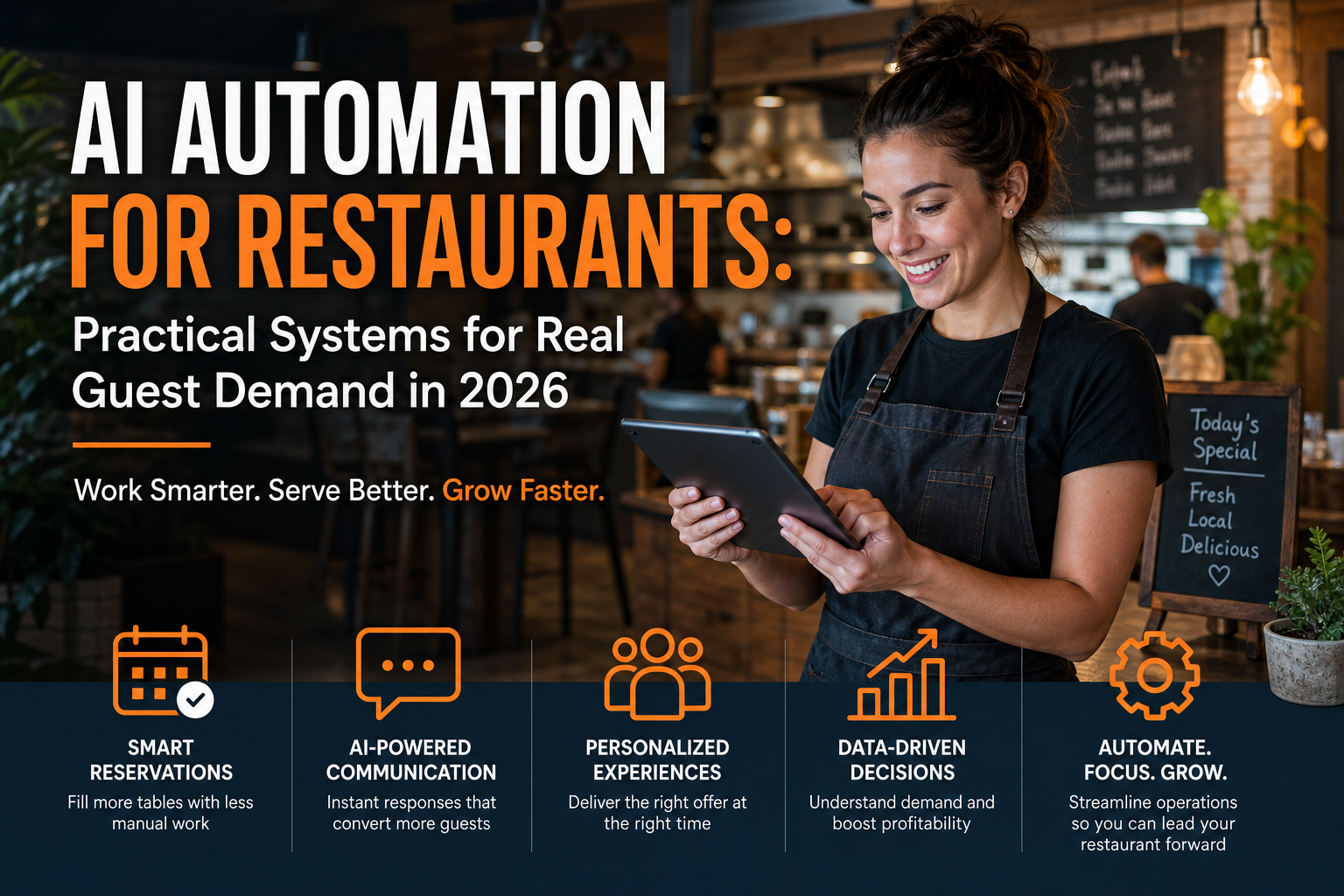
AI Automation for Restaurants means using AI to capture guest demand, route routine questions, protect staff time, and turn missed moments into measurable revenue without making hospitality feel robotic. For a small restaurant, the best starting point is not a tool list; it is the work customers already expect you to handle quickly.
That matters because restaurants are entering 2026 with demand still alive, costs still tight, and technology no longer optional. The National Restaurant Association 2026 State of the Restaurant Industry report projects $1.55 trillion in restaurant and foodservice sales, while also noting pressure around costs, traffic, productivity, digital ordering, automation, and data analytics.
For a South Bay restaurant owner, the question is not whether AI sounds impressive. The question is whether AI Automation for Restaurants can keep a real booking, catering lead, review recovery, or repeat guest from slipping through the cracks. If you want the broader small-business foundation first, the Roving Leads guide to AI Automation for Small Businesses explains the same idea outside the restaurant context.
Key Takeaways
- AI Automation for Restaurants should start with revenue leaks: missed calls, slow catering follow-up, unanswered reviews, and inconsistent search information.
- The reader does not need a vendor list first. They need to understand the capability their restaurant is missing.
- A voice agent can help only when it captures the right details and hands off real opportunities clearly.
- The best restaurant automation protects staff attention instead of creating another screen to manage.
- Owners should measure bookings, response time, review recovery, repeat visits, and staff burden before expanding.
Table of Contents
Why AI Automation for Restaurants Matters in 2026

AI Automation for Restaurants matters because operators are being asked to do more with the same staff, tighter margins, and guests who expect instant answers. The work that should move first is the work already leaking money.
The restaurant industry is not short on technology. It is short on calm, useful systems that fit the way a real shift works. A POS, reservation platform, website, phone, delivery app, and review profile can all be technically “connected” while the manager still spends Sunday night chasing missed messages.
That is the real business case. AI Automation for Restaurants should help the restaurant protect demand it already earned: the person who called after seeing a menu, the company office asking about lunch catering, the loyal guest who left a review after a rough night, or the family checking whether a table is available before they drive over.
This is why the public article should not hand the reader a stack of apps. The useful answer is the operating diagnosis. The exact build depends on call volume, reservation behavior, POS setup, review velocity, catering value, delivery mix, and who on the team has authority to approve exceptions.
The goal is not to sell a restaurant on AI. The goal is to help the owner spot where the current operation is losing demand, then decide whether the missing capability is worth building.
That is the lens this article uses. AI Automation for Restaurants is strongest when it helps a guest get a useful answer, helps staff avoid repetitive interruption, and gives the owner cleaner information. It is weakest when it turns into another dashboard nobody has time to check.
Start With Missed Demand, Not Software

The first practical use of AI Automation for Restaurants is missed-demand capture. If the phone rings during service, the website form is vague, or catering requests arrive in three different places, the restaurant needs a way to collect intent before the opportunity goes cold.
This is where a voice agent can make sense. Not a gimmick, not a replacement for hospitality, and not a bot that argues with guests. You need a voice agent that can answer routine questions, capture name and contact details, identify whether the request is a table, catering, private event, takeout issue, or allergy question, and route only the right items to a person.
The same logic applies to web chat and SMS. The restaurant does not need “AI everywhere.” It needs a guest intake path that respects the rush. If a Redondo Beach cafe gets calls about weekend brunch availability, or a Torrance restaurant gets catering questions during lunch, the system should separate useful demand from noise without making staff decode a messy transcript later.
The capability should also know when to stop. If the guest asks about a severe allergy, a private buyout, a refund, a special accommodation, or a complaint, AI Automation for Restaurants should capture the issue and escalate it. A restaurant earns trust by knowing which moments need a person.
There is a temptation to make the voice agent sound impressive. That is backwards. The best version sounds useful, brief, and easy to escape. It should ask fewer questions than a nervous employee, not more.
Restaurant automation should feel like a better host stand, not a colder restaurant.
That is why the first internal link in a restaurant article should not be a service pitch. It should help the reader understand the bigger operating pattern. The broader Roving Leads article on AI Consulting for Small Business is useful here because the decision is really about business fit, not novelty.
The Restaurant Capabilities Worth Building First
The right first build depends on where the restaurant is losing time or demand today. AI Automation for Restaurants should match the pain, not the trend.
For most independent restaurants, the highest-value capabilities are familiar: call capture, catering follow-up, review response support, menu and hours accuracy, waitlist messaging, private-event qualification, and simple reporting. None of those require the owner to reveal the exact tool stack to the public. They require a clear operational shape.
AI Automation for Restaurants should also respect priority. A ten-dollar takeout question and a two-thousand-dollar catering inquiry should not create the same manager alert. The system needs enough structure to tell the difference without pretending to be the owner.
| Restaurant symptom | Capability needed | What to measure |
|---|---|---|
| Phone rings during lunch rush | Call capture and guest intent routing | Missed-call recovery, bookings saved, catering inquiries captured |
| Catering leads sit until tomorrow | Structured follow-up with owner review | Response time, quote completion, booked catering value |
| Reviews pile up unanswered | Review triage and response drafting | Response coverage, repeated complaints, recovery opportunities |
| Menu, hours, and booking info disagree online | Search presence maintenance | Profile accuracy, search actions, direct orders |
Notice what is missing from that table: vendor names, prompt recipes, and step-by-step configuration. A public article should give the reader enough clarity to recognize the problem and judge the opportunity, while leaving the implementation details for a real conversation.
- If calls are being missed, the restaurant needs intake and routing.
- If reviews are unanswered, the restaurant needs triage and response support.
- If catering is slow, the restaurant needs structured follow-up and owner review.
- If search visibility is weak, the restaurant needs cleaner public information and better answer-ready content.
- If staff hate the system, the restaurant needs a smaller rollout with fewer interruptions.
Where Search, Menus, and AI Answers Connect

AI Automation for Restaurants is not only about internal operations. It also affects how easily guests can find accurate answers before they ever call.
Google’s own restaurant Business Profile guidance explains that restaurants can show menu information directly on Search and Maps through their Business Profile. That matters because guests often decide from search results, map listings, reviews, photos, hours, menus, and booking links before they reach the restaurant website.
This is where the line between local SEO, GEO, and operations gets practical. If the menu is outdated, the hours are wrong, the reservation path is unclear, or the website does not answer common guest questions, AI systems and search engines have less reliable material to work with. The Roving Leads guide to GEO SEO for Local Business covers this answer-ready visibility problem in more depth.
AI Automation for Restaurants can support that visibility by keeping recurring facts organized. Common questions about parking, dietary options, catering minimums, reservation rules, private events, happy hour, delivery radius, and holiday hours should not live only in one person’s head.
The restaurant still needs human taste and judgment. AI can help keep the facts consistent, draft answer-ready content, and flag stale information. It should not invent specials, rewrite the brand voice into generic copy, or answer policies the owner has not approved.
A restaurant needs consistent public facts, searchable menu context, clear booking paths, and answers to the questions guests ask before choosing where to eat.
For South Bay restaurants, this can be a real local advantage. A guest searching from Manhattan Beach, Hermosa Beach, Redondo Beach, or Torrance may never type “AI” into Google. They will search for a table, catering, takeout, private dining, or a specific dish. AI Automation for Restaurants helps only if the restaurant has the public facts and follow-up paths to catch that intent.
Protect Staff From Bad Automation

Bad AI Automation for Restaurants makes the team busier. Good automation removes repetitive interruption and leaves judgment with the people who understand the restaurant.
A host should not have to copy messages from one app into another. A manager should not have to read twenty weak AI summaries to find one catering request. A server should not have to apologize because a bot promised something the kitchen cannot deliver.
The owner-review layer is the safeguard. AI can draft, classify, remind, and route. The restaurant still decides what gets confirmed, comped, escalated, or ignored. That is especially important for hospitality because tone, timing, and context matter.
AI Automation for Restaurants should also be introduced in language staff can trust. “This catches missed calls while you are serving guests” is different from “this monitors your work.” “This drafts review replies for owner approval” is different from “this handles customer complaints.” The same workflow can land well or badly depending on how it is framed.
Staff should know the boundaries. They should know what guests will hear, what gets logged, who reviews exceptions, and how to report a bad answer. That keeps the rollout from feeling like a surprise dropped into the middle of a shift.
If automation creates more staff anxiety than it removes, the system is too big, too vague, or pointed at the wrong job.
This is also why training matters even when the article does not pitch a training service. The restaurant needs a simple agreement about who sees what, what AI is allowed to answer, when a human steps in, and how mistakes get corrected. Without that agreement, automation becomes another source of shift drama.
How to Measure Whether It Is Working

AI Automation for Restaurants should be judged by business outcomes, not by how futuristic the system sounds. The owner should know what changed after the automation went live.
Useful measurements include recovered missed calls, catering inquiries captured, average response time, booking completion, review response coverage, repeat-guest follow-up, and staff interruptions removed. The National Restaurant Association’s 2026 press release describes digital ordering, payments, loyalty, automation, and targeted marketing as ways operators are removing friction and strengthening guest engagement. The restaurant still has to connect those ideas to its own numbers.
A small restaurant does not need a giant transformation plan to start. It needs one measurable workflow with a before number and an after number. If a restaurant missed twenty-two calls last week, recovered six real inquiries this week, and booked two catering conversations that would have been lost, the owner has a real signal.
The first month should be a learning period, not a victory lap. AI Automation for Restaurants improves when the owner reviews which requests were classified correctly, which alerts were noisy, which answers were too vague, and which guest moments still needed a person sooner.
The worst metric is “the system is live.” That tells the owner nothing. A useful metric says the restaurant answered faster, captured more demand, reduced a repetitive task, or found a new pattern in guest questions.
The Square restaurant trends coverage also points toward restaurants using technology to meet customer expectations around ordering, payments, loyalty, and convenience. That aligns with the practical rule: automation should reduce friction for guests and staff at the same time.
If the system cannot show saved demand, saved time, or better guest follow-up, it is not mature enough to expand.
A South Bay Restaurant Rollout That Does Not Feel Forced
A sensible rollout for AI Automation for Restaurants starts small enough that staff can trust it. Pick one leak, one location, one owner-approved rule set, and one measurement window.
For example, a neighborhood restaurant in Redondo Beach might start with missed-call capture because dinner service overwhelms the phone. A busier operation in Torrance might start with catering qualification because corporate orders are more valuable than one-off questions. Those are local examples, not city-name stuffing. The point is that different restaurants leak revenue in different places.
The rollout should be boring on purpose. Define what AI may answer, what it may collect, what it must never promise, and when a person reviews the request. Then inspect the first week of transcripts, notes, and outcomes before adding more.
A good first workflow is narrow enough to explain in one sentence. “Capture missed catering calls and notify the owner with the guest’s name, date, budget signal, and urgency.” That is a usable restaurant capability. “Automate the business with AI” is not.
Once that first workflow proves itself, the restaurant can add a second capability. Review follow-up might come next. Search information maintenance might come next. Private-event qualification might come next. AI Automation for Restaurants should expand because the numbers say it earned more responsibility.
That approach also builds trust with the reader. Roving Leads is based in the South Bay, but a useful article should not pretend every restaurant has the same problem. The About page gives readers more context on the local operator behind the advice, and the article itself should earn the conversation before asking for it.
The South Bay Small-Business AI Starter Kit.
28 pages. Three free quick wins, five revenue areas, a self-assessment, and a simple roadmap for South Bay businesses trying to understand where AI actually makes money.
 PDF
PDF
FAQ: AI Automation for Restaurants
What is AI Automation for Restaurants?
AI Automation for Restaurants is the use of AI-assisted systems to capture demand, answer routine questions, route guest requests, support review follow-up, and reduce repetitive staff work. The practical goal is not to replace hospitality. The goal is to keep guest opportunities from slipping away when the team is busy.
What should a restaurant automate first?
A restaurant should automate the clearest revenue leak first. For many owners, that is missed-call capture, catering follow-up, review triage, or menu and hours accuracy. The right first move depends on where the restaurant is losing money or staff attention today.
Can AI answer restaurant phone calls?
Yes, AI can answer restaurant phone calls when the system has narrow rules, clear escalation points, and a human review process. It should capture guest intent, contact details, timing, and request type. It should not promise exceptions, discounts, or availability unless the restaurant has approved that behavior.
Will AI Automation for Restaurants replace staff?
Good AI Automation for Restaurants should protect staff, not replace them. The best systems remove repetitive interruptions, organize requests, and make handoffs clearer. Guests still need human hospitality for judgment, tone, exceptions, service recovery, and the parts of dining that make a restaurant memorable.
How does restaurant AI help local SEO?
Restaurant AI helps local SEO when it supports accurate public information, answer-ready content, better review response, and cleaner guest paths from search to booking or ordering. It does not replace local SEO. It gives the restaurant a better system for keeping search-visible facts and follow-up consistent.
How do I know if restaurant automation is worth it?
Restaurant automation is worth it when it improves a measurable business number. Track recovered missed calls, response time, booked catering leads, direct reservations, review coverage, repeat visits, or staff interruptions removed. If the result cannot be measured, the rollout is too vague.
Bottom Line
AI Automation for Restaurants is worth pursuing when it makes the restaurant calmer, faster to respond, and better at keeping demand it already earned. If the system makes the staff manage more screens, it is the wrong system.
Start with one leak. Measure it honestly. If the restaurant can recover demand without flattening the guest experience, AI Automation for Restaurants becomes a practical operating advantage instead of another technology project.
The clearest test is simple: AI Automation for Restaurants should make the next busy shift easier to manage and the next valuable guest request harder to miss.
What is the one restaurant process that eats the most staff time during service? We would love to hear it. Drop a comment below.
About Dave and Roving Leads: Dave works with South Bay small businesses on practical AI workflows, search visibility, and operational systems that respect the way real owners work. Learn more about the local perspective on the Roving Leads About page or start a conversation through Contact.