
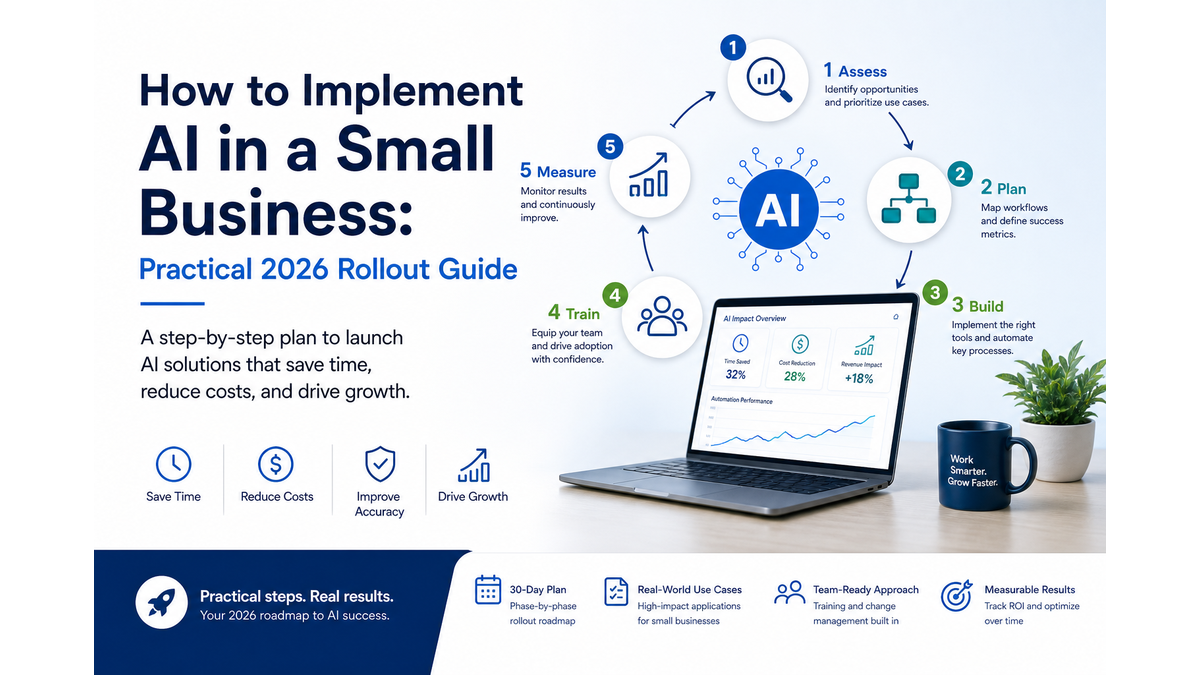
How to Implement AI in a Small Business starts with one decision: choose a real business problem before you choose a tool. That single shift separates the owners who see measurable returns from the ones who spend months experimenting and walk away frustrated. This guide gives you a practical, sequenced rollout plan built for South Bay and Los Angeles small businesses that want results in 2026, not a technology demo.
The guide covers readiness, pilot selection, human oversight, staff training, governance, and expansion. It is long because the topic deserves depth. Work through it in order, or jump to the section that matches where you are right now.
If you want a structured starting point before reading further, the South Bay Small-Business AI Starter Kit gives you a condensed checklist you can act on today.
The practical answer to How to Implement AI in a Small Business is to launch one controlled workflow, prove it, document it, and only then expand.
A useful plan for How to Implement AI in a Small Business should connect strategy to action. If you are still deciding which workflows make sense, the AI Automation for Small Businesses guide is a practical companion, and the first build should usually become a controlled Custom AI Workflow System, not a loose collection of disconnected prompts.
⚡ Key Takeaways
- How to Implement AI in a Small Business is an operating-model decision, not a software purchase.
- Start with a documented business problem. The tool comes second.
- Run one pilot workflow before expanding. Scope creep kills early momentum.
- Every AI output needs a human review gate until accuracy is proven.
- Staff training is not optional. Goldman Sachs’ 2026 research confirms that small businesses embracing AI still fall short when training is skipped.
- Governance documentation protects your business from liability, data leaks, and audit exposure.
- A 30-day rollout plan is achievable for most small teams when the sequence is followed.
Table of Contents
Start With A Business Problem, Not An AI Tool
In practice, How to Implement AI in a Small Business begins by naming one business problem clearly enough that success or failure can be measured.
The most common reason How to Implement AI in a Small Business goes wrong is that owners start with the tool. They see a demo, they buy a subscription, and then they spend weeks trying to find a use case that justifies the cost. That is backwards.
The right starting point is a list of your most expensive, most repetitive, or most error-prone business problems. Write them down. Rank them by the cost of getting them wrong and the time they consume each week. That list is your AI roadmap.
Common high-value problem categories for small businesses include: customer inquiry response time, lead follow-up delays, manual data entry, appointment scheduling friction, content production backlogs, and invoice or billing errors. Any of these can be addressed through How to Implement AI in a Small Business correctly, but only if the problem is defined before the solution is selected.
“Organizations are moving toward human-agent teams and redesigned workflows. AI implementation should be treated as operating-model design, not casual tool adoption.”
— Microsoft 2026 Work Trend Index
The Microsoft 2026 Work Trend Index frames this precisely: the shift to AI is not about adding a tool to an existing process. It is about redesigning how work gets done. For a small business, that means asking which workflows should be rebuilt around AI assistance, not just which tasks a chatbot can handle.
Once you have your problem list, filter it with three questions. First: is this problem repetitive enough that automation would save meaningful time each week? Second: is the output verifiable, meaning can a human check the AI’s work without significant effort? Third: does solving this problem directly affect revenue, customer satisfaction, or cost? Problems that pass all three filters are your best pilot candidates.

How to Implement AI in a Small Business with this problem-first approach also makes it easier to measure success later. When you know exactly what problem you were solving, you know exactly what metric to track. That clarity is what separates a pilot that earns budget approval from one that quietly gets abandoned.
Check Readiness Before You Build
For most owners, How to Implement AI in a Small Business depends less on novelty and more on whether the workflow, data, and team habits are ready.
How to Implement AI in a Small Business without a readiness check is like opening a restaurant without inspecting the kitchen. You may get through the first service, but the problems will surface fast and at the worst possible moment.
Readiness has four dimensions: data, process, people, and infrastructure. Each one can block a rollout if it is not addressed early.
| Readiness Dimension | What to Check | Common Gap | Fix Before Pilot |
|---|---|---|---|
| Data | Is your data clean, accessible, and consistently formatted? | Scattered spreadsheets, duplicate records | Consolidate and deduplicate the data the pilot will touch |
| Process | Is the target workflow documented step by step? | Process lives in someone’s head | Write a simple SOP before automating anything |
| People | Does your team understand what AI will and will not do? | Fear or over-trust, both cause errors | Run a brief expectations session before go-live |
| Infrastructure | Do your current tools support integration or API access? | Legacy software with no integration path | Identify integration method or plan a workaround |
A formal AI Readiness Assessment walks through all four dimensions systematically and surfaces the gaps that would otherwise derail your pilot two weeks in. It is one of the highest-leverage investments you can make before spending anything on implementation.
Data readiness is usually the first blocker. How to Implement AI in a Small Business successfully requires that the AI has access to accurate, consistent inputs. If your customer records are split across three tools, your email history is in someone’s personal inbox, and your product catalog is a PDF from 2022, the AI will produce unreliable outputs regardless of how good the underlying model is.
Process readiness is equally important and often overlooked. If the workflow you want to automate is not documented, you cannot automate it reliably. Write the steps down first. That documentation also becomes your quality benchmark when you evaluate AI outputs later.
People readiness is where the Goldman Sachs 2026 small business AI report draws its sharpest conclusion: small businesses are embracing AI but falling short because training and support are not built into the rollout plan. Readiness is not just about systems. It is about whether your team knows what to do when the AI is wrong, when it is right, and when it is uncertain.
How to Implement AI in a Small Business without checking infrastructure readiness leads to integration failures that stall projects for months. Know whether your current software supports webhooks, APIs, or native integrations before you commit to a workflow design that depends on them.
Pick One Workflow For The First Pilot
The safest answer to How to Implement AI in a Small Business is to start with one workflow that can prove value without disrupting the whole company.
How to Implement AI in a Small Business at scale starts with a single workflow. Not three. Not a department-wide rollout. One workflow, chosen carefully, run for 30 days, measured honestly.
The pilot workflow should meet five criteria. It should be high-frequency, meaning it happens multiple times per week. It should be low-stakes enough that an AI error does not cause serious harm before a human catches it. It should have a clear input and a clear expected output. It should be owned by one person on your team. And it should have a baseline metric you can compare against after the pilot.
Good first-pilot candidates for most South Bay small businesses include: first-response emails to new inquiries, appointment confirmation and reminder sequences, social media caption drafts for review, internal meeting summary generation, and basic invoice or quote assembly from a template. Each of these is repetitive, verifiable, and directly connected to a business outcome.
⚠️ Pilot Scope Warning
The most common pilot failure is scope creep. You start with email responses, then someone suggests adding the CRM sync, then the reporting dashboard, then the chatbot. Suddenly the pilot is a full implementation and nothing is working well. Lock the scope on day one and enforce it. Expansion comes after the pilot proves value.
How to Implement AI in a Small Business through a disciplined pilot also builds internal credibility. When your team sees one workflow running smoothly and producing measurable results, the conversation about expanding shifts from “should we do this?” to “where do we do this next?” That shift in organizational confidence is worth more than any single efficiency gain.
For businesses that need help designing the right pilot workflow, AI Automation Consulting can map your current processes and identify the highest-value starting point based on your specific operations, not a generic template.
Document everything during the pilot. Log what inputs the AI receives, what outputs it produces, how often a human modifies the output, and how long the review takes. That documentation becomes your expansion playbook and your governance record simultaneously.

Design The Human Review Layer
A serious plan for How to Implement AI in a Small Business includes human review before customers, money, or compliance risk are affected.
How to Implement AI in a Small Business responsibly requires a human review layer in every workflow until accuracy is proven. This is not a sign that the AI is not working. It is the design principle that keeps your business protected while the system earns trust.
The NIST AI Risk Management Framework structures this through four functions: Govern, Map, Measure, and Manage. For a small business, that translates to: set clear rules for AI use, document where AI touches your workflows, track accuracy and errors, and assign someone to own the ongoing monitoring. The human review layer is the operational expression of all four functions at once.
Design your review layer before the pilot goes live. Decide who reviews AI outputs, how quickly they are expected to review them, what the escalation path is when something looks wrong, and what constitutes an acceptable output versus one that needs to be rewritten. Write those decisions down. They become your AI usage policy.
How to Implement AI in a Small Business without a review layer is how businesses end up sending incorrect quotes to clients, publishing factually wrong content, or responding to customer complaints with tone-deaf automated messages. The review layer is not overhead. It is quality control for a new kind of production system.
As accuracy improves over time, the review layer can shift. A workflow that starts with full human review of every output might move to spot-check review at 20% sampling after 60 days of strong performance. That progression should be documented and approved deliberately, not allowed to drift because people get busy.
Formal AI Governance Documents give your business a structured framework for these decisions, including review protocols, escalation procedures, data handling rules, and audit trails that protect you if questions arise later.
Train The Team Before The System Goes Live
A practical approach to How to Implement AI in a Small Business treats staff training as part of the system, not an optional meeting after launch.
How to Implement AI in a Small Business without training your team is one of the most reliable ways to waste the investment. The Goldman Sachs 2026 report is direct on this point: small businesses that embrace AI but skip structured training and support consistently underperform compared to those that build enablement into the rollout plan.
Training for a small business AI rollout does not need to be a multi-day workshop. It needs to cover three things: what the AI does in this specific workflow, what the team member’s role is in reviewing and approving outputs, and what to do when something looks wrong. That is it for the first pilot. Keep it focused.
The deeper training challenge is cultural, not technical. Some team members will over-trust AI outputs and stop reviewing carefully. Others will distrust every output and spend more time second-guessing than the workflow saves. Both patterns need to be addressed directly in training, with real examples from your own business context.
Team Training and AI Workflow Rollout services are designed specifically for small business teams that need practical, role-specific enablement rather than generic AI literacy courses. The goal is that every person who touches the workflow knows exactly what to do on day one.
How to Implement AI in a Small Business also requires training the owner or manager, not just the staff. Owners need to understand how to evaluate whether the AI is performing well, how to read the metrics the pilot produces, and how to make expansion decisions based on evidence rather than enthusiasm or frustration.
✅ Training Checklist for Pilot Go-Live
- Every team member who touches the workflow has completed a role-specific walkthrough.
- The review protocol is written down and accessible, not just explained verbally.
- Everyone knows the escalation path when an AI output is wrong or uncertain.
- The owner or manager has reviewed the baseline metrics and knows what success looks like.
- A 30-day check-in is scheduled before the pilot ends.
For owners who are navigating How to Implement AI in a Small Business without a technical team, Solopreneur AI Coaching offers a structured path through the decisions and skills you need to run AI-assisted workflows without hiring a developer or a full consulting team.
Measure Results And Expand Carefully
The long-term answer to How to Implement AI in a Small Business is measure, improve, and expand only after the first pilot earns trust.
How to Implement AI in a Small Business at scale requires that you measure the pilot honestly before you expand. This sounds obvious, but the pressure to move fast often pushes owners to declare success before the data supports it, or to abandon a promising pilot because early results were messy.
Set your measurement criteria before the pilot starts. Choose two or three metrics that directly reflect the problem you were solving. If the pilot was about reducing response time on new inquiries, measure average response time before and after. If it was about reducing time spent on content drafts, measure hours per week. If it was about appointment confirmation rates, measure no-show rates. Tie the metric to the original problem statement.
Also measure what you did not intend to affect. Sometimes a workflow change that improves speed creates errors elsewhere. Sometimes it shifts workload in ways that create new bottlenecks. A 30-day pilot review should look at the whole system, not just the target metric.
How to Implement AI in a Small Business across multiple workflows requires a sequenced expansion plan. After the first pilot succeeds, identify the next two or three candidate workflows using the same problem-first filter. Do not run three new pilots simultaneously. Run one at a time, let it stabilize, then add the next. The compounding effect of well-run sequential pilots is far more powerful than a chaotic parallel rollout.
The Custom AI Workflow Systems service is designed for businesses that have proven a pilot and are ready to build more sophisticated, integrated automation across multiple workflows without rebuilding from scratch each time.
Expansion decisions should also revisit governance. Each new workflow that touches customer data, financial information, or public-facing content needs its own review protocol and its own entry in your AI usage documentation. How to Implement AI in a Small Business responsibly means that governance scales with the system, not just the capabilities.

Common AI Implementation Mistakes To Avoid
The easiest way to misunderstand How to Implement AI in a Small Business is to confuse tool access with implementation.
How to Implement AI in a Small Business is well-documented in theory. The mistakes that derail real rollouts are less often discussed. Here are the ones that show up most consistently in small business implementations.
- Buying the tool before defining the problem. The most common mistake. The tool shapes the solution instead of the problem shaping the tool selection.
- Skipping the readiness check. Dirty data and undocumented processes guarantee poor AI outputs. No model overcomes bad inputs.
- Running too many pilots at once. Spreading attention across three simultaneous pilots means none of them get the focus they need to succeed.
- Removing human review too early. Accuracy needs to be earned over time. Removing oversight before it is warranted is how errors reach customers.
- Treating training as a one-time event. AI tools evolve. Workflows change. Training needs to be refreshed when either happens.
- Ignoring governance until something goes wrong. By then, the documentation is reactive rather than protective. Build governance in from the start.
- Measuring the wrong things. Tracking usage metrics like “prompts sent” instead of outcome metrics like “response time reduced” tells you nothing about whether How to Implement AI in a Small Business is actually working.
- Letting enthusiasm drive expansion instead of data. The pilot results should drive the expansion decision, not the excitement of seeing the AI do something impressive in a demo.
How to Implement AI in a Small Business without falling into these patterns is easier when you have a structured framework and an outside perspective. The AI Consulting for Small Business guide covers the full landscape of what good implementation looks like and what to watch for at each stage.
One mistake that deserves special attention is the assumption that How to Implement AI in a Small Business is a one-time project. It is not. AI tools change. Your business changes. The workflows that work well today may need to be redesigned in six months. Build a review cadence into your plan from the beginning, not as an afterthought.
A Practical 30-Day Rollout Plan
This 30-day plan turns How to Implement AI in a Small Business into a sequence of decisions, tests, training, and measurement.
How to Implement AI in a Small Business in 30 days is achievable for most small teams when the sequence is followed and the scope is disciplined. This plan assumes you have completed the readiness check and selected your pilot workflow before day one.
| Week | Focus | Key Actions | Owner |
|---|---|---|---|
| Week 1 | Foundation | Document the target workflow SOP, clean the data the pilot will use, write the review protocol, set baseline metrics | Owner + Workflow Lead |
| Week 2 | Build and Train | Configure the AI workflow, run team training session, complete a dry run with test inputs, document any adjustments needed | Owner + Implementation Partner |
| Week 3 | Live Pilot | Go live with full human review on every output, log all outputs and review decisions, note any errors or edge cases | Workflow Lead |
| Week 4 | Measure and Decide | Compare metrics against baseline, review error log, decide: expand, adjust, or pause, document governance record for the pilot | Owner |
Week one is the most important week. Owners who rush through foundation work to get to the “AI part” consistently struggle in weeks three and four. The SOP documentation, the data cleanup, and the review protocol are not prerequisites to the real work. They are the real work.
Week two training should be practical, not theoretical. Use real examples from your own business. Show the team what a good AI output looks like in your context, what a bad one looks like, and exactly what to do in each case. Abstract AI training does not prepare people for the specific workflow they will be managing.
Week three is where How to Implement AI in a Small Business becomes real. Expect some friction. Expect some outputs that need significant editing. That is normal in week one of a live pilot. Log everything without judgment. The logs are your data, and your data is your decision-making tool.
Week four is a business decision, not a technical one. Look at the metrics. Look at the error log. Ask whether the workflow is producing value relative to the time invested in review and management. If yes, plan the expansion. If not, diagnose the specific failure point before deciding whether to adjust or pause. How to Implement AI in a Small Business well means being willing to pause a pilot that is not working and fix the root cause before moving forward.
For businesses in the South Bay ready to run this plan with support, the AI Automation for Small Businesses resource covers the workflow patterns that produce the most consistent results for local operations in this market.
Owners who want a guided version of this 30-day plan, with checkpoints and accountability built in, can explore AI Consulting for Small Business to see how a structured engagement supports the rollout from readiness through expansion.

The South Bay Small-Business AI Starter Kit.
28 pages. Three free quick wins, five revenue areas, a self-assessment, and a simple roadmap for South Bay businesses trying to understand where AI actually makes money.
 PDF
PDF
FAQ – How to Implement AI in a Small Business
How long does it realistically take to implement AI in a small business?
A focused first pilot can go from readiness check to live workflow in 30 days for most small businesses. Full implementation across multiple workflows, with governance and training built in, typically takes three to six months depending on the complexity of your operations and how many workflows you are targeting. How to Implement AI in a Small Business is not a one-week project, but it does not need to take a year either. The 30-day plan in this guide is realistic when the scope is disciplined and the foundation work is done in week one.
Do I need a technical background to implement AI in my small business?
No. How to Implement AI in a Small Business does not require coding skills or a technical background. It requires clear thinking about your business problems, a willingness to document your processes, and the discipline to follow a sequenced plan. The technical configuration of AI tools is something an implementation partner or consultant handles. Your job as the owner is to define the problem, own the governance decisions, and evaluate the results. That is a business skill, not a technical one.
What is the biggest risk of implementing AI in a small business?
The biggest operational risk is removing human review before accuracy is proven, which allows AI errors to reach customers, clients, or financial records unchecked. The biggest strategic risk is implementing AI in workflows that do not matter enough to justify the investment, which produces activity without returns. How to Implement AI in a Small Business safely means building the review layer in from day one and choosing pilot workflows that are directly connected to revenue, cost, or customer experience outcomes.
How do I know if my business is ready to implement AI?
Readiness comes down to four dimensions: clean and accessible data, documented processes, a team that understands what AI will and will not do, and software infrastructure that supports integration. If any of those four are missing, the first step is closing that gap, not selecting an AI tool. A formal AI Readiness Assessment surfaces exactly which gaps exist and what to address before building anything.
How much does it cost to implement AI in a small business?
Costs vary significantly based on the complexity of the workflows, whether you need custom integration work, and whether you are using off-the-shelf tools or purpose-built systems. A simple first pilot using existing software capabilities might cost very little beyond staff time. A custom multi-workflow system with governance documentation and training can range from a few thousand dollars to significantly more depending on scope. How to Implement AI in a Small Business cost-effectively means starting with the highest-value, lowest-complexity pilot and letting proven results justify the investment in more sophisticated systems.
⬛ Bottom Line
How to Implement AI in a Small Business is a business discipline, not a technology project. It starts with a real problem, runs through a readiness check, launches with a single disciplined pilot, protects outputs with a human review layer, trains the team before go-live, measures results honestly, and expands based on evidence.
The 30-day plan in this guide is achievable. The mistakes section tells you exactly what to avoid. The research from Microsoft, Goldman Sachs, and NIST gives you the framework to make decisions that hold up over time.
If you are ready to start and want a structured path through the decisions, reach out to Roving Leads or explore the full range of AI services for South Bay small businesses. How to Implement AI in a Small Business is a process. You do not have to figure it out alone.