
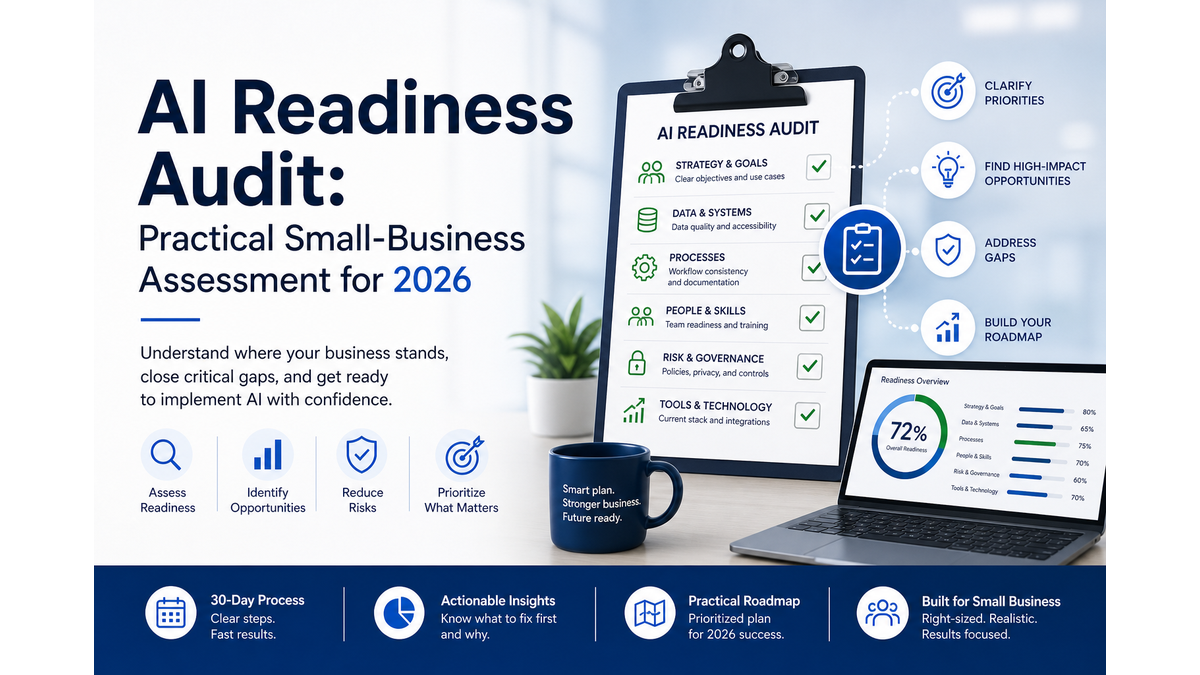
An AI Readiness Audit is a structured assessment that examines whether your business’s workflows, data, people, governance, and leadership alignment are prepared to support AI before you spend a dollar on tools. It is not a software checklist. It is an honest look at the organizational conditions that determine whether AI will actually work inside your specific operation — or quietly fail after a promising demo.
Most small business owners in the South Bay and greater Los Angeles area are curious about AI. Many have already experimented with it. But curiosity and a few successful prompts are not the same as readiness. A proper AI Readiness Audit closes that gap by surfacing what needs to be in place before you commit to a workflow change, a new system, or a staff training program.
If you want a guided version of this process, AI Readiness Assessments from Roving Leads are built specifically for small businesses that want a clear answer, not a sales pitch. But this article gives you the full framework so you can evaluate your own situation first.
Local context matters too: a service business in Redondo Beach may have different lead-response, staffing, and customer-experience gaps than a back-office team with the same tool stack.
🔑 Key Takeaways
- An AI Readiness Audit evaluates organizational conditions — not just technology — before AI adoption begins.
- The Microsoft 2026 Work Trend Index confirms that the AI gap is most often an organizational readiness problem, not a tool problem.
- Goldman Sachs research shows small businesses are adopting AI but still need training and support to make it work — exactly what a readiness audit surfaces.
- The five audit areas are: workflows, data, people, governance, and leadership alignment.
- A good AI Readiness Audit produces a written action plan, not just a score or a recommendation to buy something.
- Skipping the audit phase is the most common reason AI projects stall or fail inside small businesses.
- Local businesses in areas like Torrance, Redondo Beach, and across the South Bay can use an AI Readiness Audit to move from experimentation to reliable, repeatable AI use.
Table of Contents
What An AI Readiness Audit Actually Checks
The phrase “AI readiness” gets used loosely, so it helps to be specific. An AI Readiness Audit is not asking whether you have heard of ChatGPT or whether your industry is using AI. It is asking whether your specific business — your team, your data, your processes, your decision-making culture — has the conditions that allow AI to produce consistent, trustworthy results.
Think of it like a building inspection before a renovation. The contractor does not start tearing down walls until they know what the structure can support. An AI Readiness Audit is that inspection for your business operations.
Here is what a thorough AI Readiness Audit actually examines:
- Workflow documentation: Are your core processes written down or do they live only in someone’s head?
- Data quality and access: Is the information AI would use clean, current, and accessible — or scattered across spreadsheets, inboxes, and memory?
- Staff readiness: Does your team understand what AI can and cannot do, and do they have the skills to use it responsibly?
- Governance and policy: Do you have any rules about how AI-generated content or decisions get reviewed before they reach customers?
- Leadership alignment: Does ownership or management actively support AI adoption, or is it a side project with no real backing?
- Risk and privacy exposure: Have you identified which workflows involve sensitive data that requires extra care before AI touches it?
- Measurement baseline: Do you know what “better” looks like, so you can tell whether AI is actually helping after it is deployed?
An AI Readiness Audit that skips any of these areas is incomplete. You might still learn something useful, but you are leaving the most common failure points unchecked.
The NIST AI Risk Management Framework organizes AI governance around four functions: govern, map, measure, and manage. An AI Readiness Audit for a small business maps directly onto that structure — checking governance maturity, mapping current workflows, establishing measurement baselines, and identifying risk management gaps before any tool is introduced.

If you are building AI into client-facing workflows, content production, or lead follow-up, the Custom AI Workflow Systems service starts with exactly this kind of diagnostic before any build begins. That sequencing is intentional — and it matters.
Why Readiness Comes Before AI Tools
The instinct for most business owners is to start with the tool. They see a demo, hear about a competitor using AI, or get a recommendation from a vendor — and the next question is “which one do I buy?” An AI Readiness Audit deliberately interrupts that sequence, and for good reason.
The Microsoft 2026 Work Trend Index makes this point clearly: the gap between AI interest and AI results is most often an organizational readiness problem, not a technology problem. Culture, manager support, clear usage rules, governance maturity, and whether AI use is actually encouraged and recognized inside the organization — these are the variables that predict whether AI delivers value. An AI Readiness Audit checks all of them before a single tool is selected.
The same pattern shows up in small business research. Goldman Sachs’ 2026 small business AI report found that small businesses are genuinely embracing AI — but the businesses that struggle are the ones that adopted tools without addressing training, workflow ownership, and practical support structures. An AI Readiness Audit surfaces those gaps before they become expensive problems.
“The AI gap is most often an organizational readiness problem, not a tool problem. Culture, manager support, clear rules, and governance maturity are what separate AI that works from AI that disappoints.”
— Microsoft 2026 Work Trend Index
Consider a practical example. A service business in the South Bay decides to use AI to handle initial client inquiry responses. The tool is capable. But if the intake process is not documented, if staff do not know which responses need human review, and if there is no policy about what the AI is allowed to say on the company’s behalf — the tool will create more problems than it solves. An AI Readiness Audit would have caught all three of those gaps before deployment.
This is also why an AI Readiness Audit is not a one-time event for fast-growing businesses. As your workflows evolve, your team changes, or your AI use cases expand, the readiness conditions shift. Businesses that treat the audit as an ongoing practice — rather than a checkbox — tend to get compounding returns from AI over time.
For a broader look at how this fits into an overall AI strategy, the guide on AI Consulting for Small Business covers how readiness, tool selection, and implementation connect as a system rather than a sequence of isolated decisions.
If you are earlier in the process and want to understand what an AI consultant actually does during this kind of engagement, What Does an AI Consultant Do? walks through the practical scope of that work.
The Five Areas Every Small Business Should Audit
A complete AI Readiness Audit for a small business covers five distinct areas. Each one can be assessed independently, but they interact — a weakness in one area often reveals a related gap in another. Here is what each area involves and what evidence you are looking for.

1. Workflow Readiness
AI works best when it is inserted into a process that is already defined. If your workflows are undocumented, inconsistent, or dependent on informal knowledge, AI will inherit that chaos rather than fix it.
An AI Readiness Audit in this area asks: Which workflows are candidates for AI? Are they documented in enough detail that a new team member — or an AI system — could follow them? Where are the decision points that require human judgment, and are those clearly identified?
The evidence you want to see: written process documentation, clear ownership for each workflow, and a list of tasks that are repetitive, rule-based, and time-consuming — because those are the highest-value targets for AI assistance.
2. Data Readiness
AI systems are only as reliable as the data they work with. An AI Readiness Audit in this area is not asking whether you have a lot of data — it is asking whether the data you have is clean, accessible, and appropriate for AI use.
Key questions: Where does your business data live? Is it consolidated or fragmented across multiple platforms? Is it current and accurate? Does any of it include personally identifiable information, health data, or financial records that require special handling before AI can touch it?
Data readiness is where many small businesses discover their first significant gap. The fix is usually not technical — it is organizational. It means deciding who owns data quality and building a habit of keeping records clean before AI is ever introduced.
3. People and Skills Readiness
An AI Readiness Audit of your team is not a test of technical sophistication. It is an assessment of whether your staff understands AI well enough to use it responsibly, recognize its errors, and take ownership of the outputs it produces.
Goldman Sachs’ research is direct on this point: small businesses that struggle with AI are not failing because the tools are bad. They are failing because staff were not prepared to work alongside AI with appropriate skepticism and skill. An AI Readiness Audit identifies which roles will interact with AI most directly and what training those roles need before deployment.
The Team Training and AI Workflow Rollout service is designed specifically for this gap — building the practical skills and confidence your team needs to make AI work in daily operations, not just in a demo environment.
4. Governance Readiness
Governance is the area most small businesses skip — and the one that creates the most risk. An AI Readiness Audit in this area asks whether you have any written policies about how AI is used inside your business.
That includes: What AI tools are approved for business use? What data can be entered into those tools? Who reviews AI-generated content before it is published or sent to a client? What happens when AI produces an error that reaches a customer?
The NIST AI Risk Management Framework’s “govern” function covers exactly this territory. An AI Readiness Audit that uses this framework checks whether your governance documentation is in place, whether it is understood by your team, and whether it is specific enough to actually guide behavior — not just exist as a policy document no one reads.
If your governance documentation is missing or thin, AI Governance Documents are a practical starting point for getting the right policies in place before AI use expands.
5. Leadership and Culture Readiness
The Microsoft 2026 Work Trend Index is emphatic: AI adoption succeeds when leadership actively supports it, recognizes AI use, and creates a culture where experimentation is encouraged and mistakes are treated as learning opportunities rather than failures.
An AI Readiness Audit in this area asks whether ownership and management are genuinely aligned behind AI adoption — not just interested in it. Is there a designated person responsible for AI initiatives? Is there budget allocated? Is there a plan for communicating changes to staff?
Without leadership alignment, even a technically perfect AI implementation will stall. An AI Readiness Audit surfaces this early, when it is still easy to address, rather than after a failed rollout.
How To Score AI Readiness Without Overcomplicating It
One of the most common objections to running an AI Readiness Audit is that it sounds complicated or time-consuming. It does not have to be. For a small business, a practical AI Readiness Audit can be completed in a focused half-day session if you know what you are looking for.
The goal is not a perfect score — it is an honest picture of where you stand across the five areas so you can prioritize what to address first. Here is a simple scoring approach that works without requiring a consultant or a complex tool.
| Audit Area | Not Ready (1) | Partially Ready (2-3) | Ready (4-5) |
|---|---|---|---|
| Workflow Documentation | Processes exist only in memory; no documentation | Some processes written; others informal | Core workflows documented with clear ownership |
| Data Quality | Data scattered, outdated, or inaccessible | Some data consolidated; quality inconsistent | Data clean, current, and accessible for AI use |
| People and Skills | Team has no AI exposure or training | Some staff experimenting; no structured skills | Team trained on AI use, limits, and review process |
| Governance | No AI policies exist | Informal rules; nothing written or communicated | Written policies covering tools, data, review, and errors |
| Leadership Alignment | No clear owner; no budget; no plan | Interest exists but no formal commitment | Owner/manager leading AI adoption with resources allocated |
| Measurement Baseline | No metrics tracked; no baseline exists | Some metrics tracked; not tied to AI goals | Clear metrics defined for evaluating AI impact |
Score each area honestly. A total score below 12 suggests your business needs foundational work before AI tools are introduced. A score between 12 and 20 means you are partially ready — you can begin in specific areas while building readiness in others. A score above 20 means your business has the conditions in place to move forward with a structured AI implementation.
The score is a starting point, not a verdict. An AI Readiness Audit is most valuable when it leads to a specific action plan — not when it produces a number that sits in a drawer.
⚠️ Readiness Callout: The Hidden Gap
Most small businesses score reasonably well on workflow and data readiness — and poorly on governance and leadership alignment. That imbalance is exactly where AI projects fail. An AI Readiness Audit that only checks the technical side misses the organizational conditions that actually determine success. Make sure your audit covers all five areas before you draw any conclusions.
For businesses that want a more structured assessment with an outside perspective, professional AI Readiness Assessments provide a facilitated version of this process with a written findings report and a prioritized action plan.
What A Good AI Readiness Audit Should Produce
An AI Readiness Audit is only as useful as what it produces at the end. A vague summary of strengths and weaknesses is not enough. A good AI Readiness Audit should produce four specific outputs that your business can act on immediately.

1. A Written Findings Report
The findings report documents what the AI Readiness Audit discovered across each of the five areas. It should be specific enough that someone who was not in the room can understand exactly what was assessed, what was found, and why it matters.
Vague findings like “data quality needs improvement” are not useful. Specific findings like “client contact records are split across three platforms with no single source of truth, which prevents AI from accessing reliable customer history” give you something to act on.
2. A Prioritized Gap List
Not every gap identified in an AI Readiness Audit needs to be fixed before you can begin using AI. Some gaps are blockers — they will cause AI to fail if not addressed first. Others are risks — they should be addressed soon but will not prevent initial progress. And some are improvements — nice to have but not urgent.
A good AI Readiness Audit categorizes gaps this way so you can make smart sequencing decisions rather than trying to fix everything at once.
3. A 90-Day Action Plan
The action plan translates the gap list into specific steps, owners, and timelines. For a small business, a 90-day horizon is practical — long enough to make real progress, short enough to stay focused.
The action plan from an AI Readiness Audit should answer: What gets fixed first? Who is responsible? What does success look like at the 30-, 60-, and 90-day marks? What AI use cases are approved to begin once the blockers are resolved?
4. Governance Starter Documents
If the AI Readiness Audit reveals that governance documentation is missing — which it usually does for small businesses — the audit process should produce at least a starter set of policies. That includes an AI acceptable use policy, a data handling guideline for AI tools, and a review process for AI-generated outputs.
These do not need to be long or complex. They need to be specific enough that your team knows what is and is not allowed, and what to do when something goes wrong. The AI Governance Documents service builds these for small businesses that need them in place quickly and correctly.
Local Signs Your Business Is Ready For AI
Running an AI Readiness Audit in the abstract is useful. But it helps to see what readiness actually looks like in the kind of businesses that operate across the South Bay — the service providers, contractors, retail shops, real estate offices, and professional services firms that make up the local economy from Torrance to El Segundo.
Here are the practical signs that a local small business is genuinely ready for AI — not just interested in it:
- You can describe your top three workflows in writing in under ten minutes, including who owns each step.
- Your customer or client data is stored in one primary system, not spread across email threads, spreadsheets, and sticky notes.
- At least one person on your team has used AI tools for a real work task — not just to play with — and can explain what worked and what did not.
- You have a clear sense of which tasks take the most time relative to their value, and those tasks are repetitive enough that a rule-based system could handle them.
- You are willing to write down a policy about AI use before you deploy it, even if that policy is simple.
- Ownership is actively involved in the decision to adopt AI — not delegating it entirely to a staff member or an outside vendor.
None of these signs require technical sophistication. They require organizational clarity — the same clarity that makes any operational improvement work, whether it involves AI or not.
Businesses in Torrance and across the South Bay corridor often come to an AI Readiness Audit after a frustrating first attempt with AI tools — where the tool worked fine but the results were inconsistent or the team did not adopt it. In almost every case, the issue was organizational readiness, not the tool itself. The AI Readiness Audit is what makes the second attempt different from the first.
For businesses that are earlier in the process — still building the foundational habits that readiness requires — the South Bay Small-Business AI Starter Kit is a practical resource for getting oriented before a full AI Readiness Audit begins.
✅ Readiness Signal: The Documentation Test
Before scheduling a formal AI Readiness Audit, try this quick test: Pick your most time-consuming recurring task and write down every step it involves. If you can do that clearly in 15 minutes, you have the workflow clarity that AI needs to be useful. If you struggle to get past the first few steps, that gap is your first audit finding — and it is fixable before you spend anything on tools.
For businesses in Redondo Beach, Hermosa Beach, and the beach cities corridor, the Redondo Beach AI Consulting page covers how local service businesses in that area are approaching AI readiness in practice — including the specific workflow patterns that tend to be most AI-ready in that market.
Mistakes That Make AI Readiness Audits Useless
An AI Readiness Audit done poorly is not neutral — it is actively misleading. It can give a business false confidence that it is ready when it is not, or false discouragement that it is not ready when it actually is. Here are the most common mistakes that undermine the value of an AI Readiness Audit.
Treating It As A Technology Checklist
The most frequent mistake is running an AI Readiness Audit that only asks about tools, software, and integrations. “Do you have a CRM? Do you use cloud storage? Is your website on a modern platform?” These questions have value, but they miss the organizational conditions that actually determine AI success.
An AI Readiness Audit that skips culture, governance, leadership alignment, and staff readiness is checking the wrong things. You can have excellent technology infrastructure and still fail at AI if the organizational conditions are not in place.
Doing It Once And Never Revisiting
An AI Readiness Audit is a snapshot, not a permanent certification. Your business changes. Your team changes. The AI tools available to you change. A readiness assessment that was accurate 18 months ago may not reflect your current situation — especially if you have added staff, changed workflows, or started using new platforms.
Businesses that get the most value from an AI Readiness Audit treat it as an annual practice, or run a lighter version whenever a significant operational change occurs.
Letting It End With A Score Instead Of A Plan
A score without a plan is just a number. An AI Readiness Audit that produces a readiness percentage but no specific action steps has not actually helped the business move forward. The score is a diagnostic tool. The action plan is the point.
If your AI Readiness Audit ends with a summary and a recommendation to “consider AI tools when ready,” it has not done its job. Push for specificity: what needs to change, who is responsible, and what the timeline is.
Excluding Ownership From The Process
An AI Readiness Audit that is conducted entirely by a staff member or an outside consultant — without direct input from the business owner or senior leadership — will miss the leadership alignment dimension entirely. And as the Microsoft research confirms, that dimension is often the deciding factor in whether AI adoption succeeds.
Ownership does not need to run the audit. But they need to be in the room for the leadership and governance portions, or the findings in those areas will be incomplete.
Confusing Enthusiasm With Readiness
A team that is excited about AI is an asset. But enthusiasm is not the same as readiness. An AI Readiness Audit that scores “people readiness” based on how excited staff are — rather than whether they have the skills, training, and governance context to use AI responsibly — will produce an inflated score that leads to premature deployment.
Measure skills and structures, not sentiment. Enthusiasm can be channeled productively once the readiness conditions are in place.
Your Next Step After The Audit
Once your AI Readiness Audit is complete and you have a findings report, a prioritized gap list, and a 90-day action plan, the question becomes: what do you do with it?
The answer depends on what the audit found. Here is how to think about the most common post-audit paths.
If Your Score Is Low: Build Foundations First
A low readiness score is not a reason to delay AI indefinitely — it is a roadmap for what to build first. Start with workflow documentation, because that is the foundation everything else depends on. Then address data consolidation. Then governance. Leadership alignment can often be developed in parallel with these foundational steps.
For solopreneurs and very small teams, Solopreneur AI Coaching is a practical way to build these foundations without the overhead of a full consulting engagement.
If Your Score Is Moderate: Start In Your Strongest Area
A moderate readiness score usually means you have one or two areas that are genuinely ready and two or three that need work. The smart move is to begin AI deployment in the areas where you are already ready — capturing real value and building organizational confidence — while continuing to address the gaps in other areas.
This approach also gives you real-world evidence about what AI can do for your specific business, which makes the case for continued investment much easier to make internally.
If Your Score Is High: Move To Implementation Planning
A high readiness score means your business has the organizational conditions in place to move forward with structured AI implementation. The next step is identifying your highest-value use cases, selecting appropriate tools, and building the workflows that will make AI a reliable part of your operations.
The AI Automation Consulting service is designed for exactly this stage — translating readiness into working systems that produce measurable results. And if your use cases involve custom workflow automation, Custom AI Workflow Systems builds the specific integrations your business needs rather than forcing you into off-the-shelf solutions.

Regardless of your score, the AI Readiness Audit gives you a clear, honest picture of where you stand. That clarity is worth more than any tool recommendation, because it means your next AI investment — whether in training, governance, workflow design, or technology — is aimed at the right target.
If you want to explore what a professional AI Readiness Audit looks like for your specific business, the AI Readiness Assessments service page covers the process, what is included, and how to get started. You can also contact Roving Leads directly with questions before committing to anything.
The South Bay Small-Business AI Starter Kit.
28 pages. Three free quick wins, five revenue areas, a self-assessment, and a simple roadmap for South Bay businesses trying to understand where AI actually makes money.
 PDF
PDF
FAQ – AI Readiness Audit
What is an AI Readiness Audit and why does a small business need one?
An AI Readiness Audit is a structured assessment of whether your business has the workflows, data, people, governance, and leadership alignment needed to support AI before tools are introduced. Small businesses need one because AI adoption without readiness produces inconsistent results, wasted investment, and staff frustration. The AI Readiness Audit surfaces the specific gaps that need to be addressed first, so that when AI is deployed, it works reliably rather than occasionally.
How long does an AI Readiness Audit take for a small business?
A focused AI Readiness Audit for a small business can be completed in a half-day to a full day, depending on the complexity of your operations and how much documentation already exists. A facilitated AI Readiness Audit with an outside consultant typically takes one to two structured sessions plus a report preparation period. The goal is not exhaustiveness — it is actionability. A useful AI Readiness Audit produces a clear picture and a prioritized action plan, not a 50-page document.
Can I run an AI Readiness Audit myself, or do I need a consultant?
You can run a self-directed AI Readiness Audit using the five-area framework described in this article, and many small business owners do exactly that as a starting point. The limitation of a self-directed AI Readiness Audit is that it is easy to overlook gaps in areas where you are not sure what “good” looks like — particularly governance and leadership alignment. A facilitated AI Readiness Audit with an experienced consultant adds outside perspective and ensures that the findings are specific and actionable rather than general. For businesses that want the facilitated version, AI Readiness Assessments are available as a structured engagement.
What is the difference between an AI Readiness Audit and an AI strategy?
An AI Readiness Audit is diagnostic — it tells you where you are. An AI strategy is directional — it tells you where you are going and how. The AI Readiness Audit comes first, because your strategy should be built on an honest assessment of your current conditions. A strategy built without a readiness audit is built on assumptions, and those assumptions are often wrong in ways that only become visible after a failed implementation. Think of the AI Readiness Audit as the foundation that makes your AI strategy realistic and executable.
How often should a business repeat an AI Readiness Audit?
For most small businesses, an annual AI Readiness Audit is a reasonable cadence. You should also consider a lighter-version AI Readiness Audit whenever a significant operational change occurs — a new hire in a key role, a major workflow change, a new AI tool being considered, or a change in the types of data your business handles. The AI Readiness Audit is a snapshot, not a permanent certification, and your readiness conditions change as your business evolves.
🏁 Bottom Line
An AI Readiness Audit is the most practical investment a small business can make before adopting AI — because it determines whether your next AI dollar will produce results or produce frustration. The research is consistent: the gap between AI interest and AI results is organizational, not technological. Workflows, data, people, governance, and leadership alignment are what make AI work inside a real business.
A good AI Readiness Audit does not tell you which tools to buy. It tells you whether your business is ready to use them well — and exactly what needs to change if it is not. That clarity is what separates businesses that get lasting value from AI from businesses that run expensive experiments and conclude that “AI just did not work for us.”
If you are ready to run a proper AI Readiness Audit for your South Bay business, start with a professional AI Readiness Assessment or reach out to discuss your situation before committing to any tools or systems.
The businesses that will get the most from AI in 2026 and beyond are not necessarily the ones with the most sophisticated tools. They are the ones that did the organizational work first — and an AI Readiness Audit is how that work begins.