
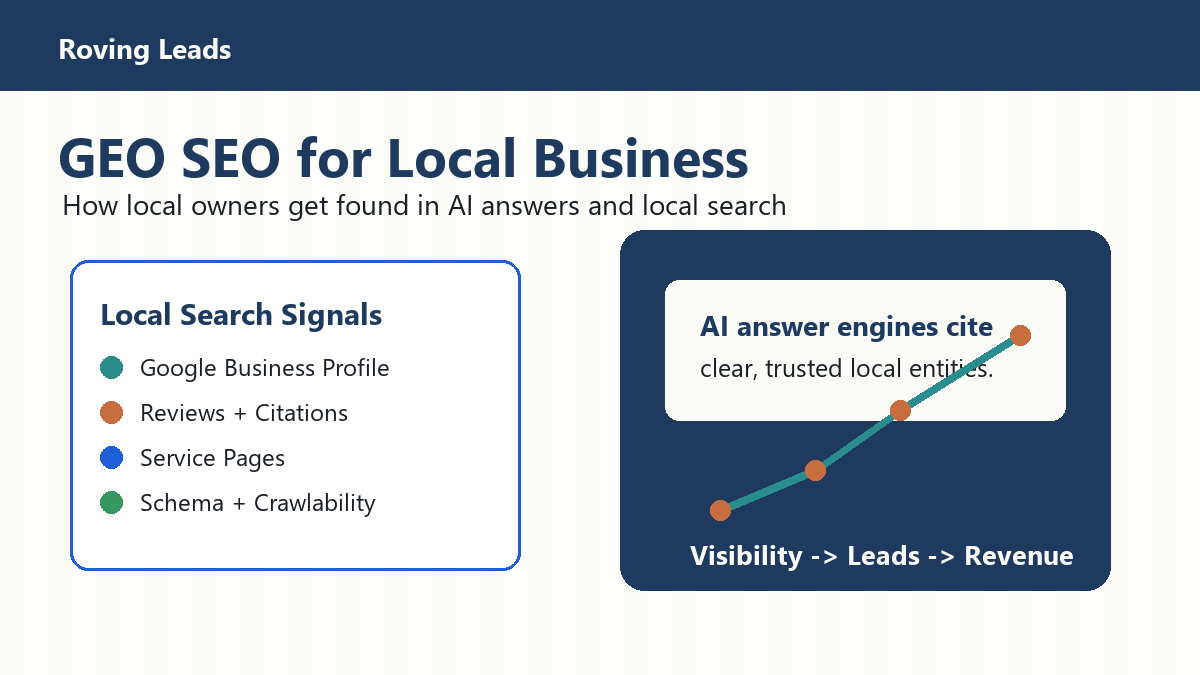
GEO SEO for local business means making your business easy for both humans and AI answer engines to find, understand, and cite — and it starts with the same local SEO fundamentals you may already know. If your Google Business Profile is incomplete, your NAP data is inconsistent across the web, or your service pages are thin, no amount of “AI optimization” will fix your visibility in Google AI Overviews, ChatGPT recommendations, or Perplexity citations. The good news: the practical steps are the same steps that have always mattered for local search. You just need to execute them more precisely in 2026.
Key Takeaways
- GEO SEO for local business is not a new channel — it is your existing local SEO made more structured, consistent, and citable.
- Google’s own documentation confirms that existing SEO best practices remain relevant for AI Overviews and AI Mode.
- The foundation is: complete Google Business Profile, clean NAP, service/location pages, LocalBusiness schema, reviews, crawlable text, and earned citations.
- AI search visibility sits on those same signals — not on tricks or keyword stuffing.
- South Bay businesses in Torrance, Redondo Beach, and Lawndale face the same GEO challenges as any local market.
- The 30-day checklist in this article gives you a realistic starting point without wasted spend.
What GEO SEO Means for a Local Business

GEO stands for Generative Engine Optimization. The term was introduced in a 2023 research paper by Aggarwal et al. at arXiv, which reported visibility boosts of up to 40% in generative engine responses when content was optimized for extraction. That sounds exciting — but the same paper noted that effectiveness varies by domain and that generic tricks are weaker than domain-specific, useful content.
For a local business, GEO SEO for local business translates to one clear question: Can an AI answer engine understand who you serve, what you do, where you operate, and why you should be trusted? If the answer is no, you will not appear in AI-generated answers — regardless of your traditional rankings.
GEO SEO for local business is not a replacement for local SEO. It is local SEO made more structured, more citable, and more consistent across every surface where AI systems look for signals.
Definition Box
Generative Engine Optimization (GEO) is the practice of structuring and presenting your content so that AI-powered answer engines — like Google AI Overviews, AI Mode, ChatGPT, and Perplexity — can accurately extract, cite, and surface your business in response to relevant queries. For local businesses, GEO SEO for local business is primarily about entity clarity and citation-readiness.
Why Local SEO Still Comes First

Before you spend a dollar on anything labeled “AI optimization,” your local SEO foundation must be solid. Google’s own guidance on improving local ranking is clear: relevance, distance, and prominence drive local results. Prominence is built through links, reviews, review count, and positive ratings — not through AI-specific tactics.
GEO SEO for local business fails without this foundation because AI systems pull from indexed, crawlable, snippet-eligible pages. If your most important pages block snippets — even accidentally — they cannot appear in AI Overviews or AI Mode. Google’s robots meta tag documentation confirms that nosnippet and max-snippet directives apply directly to AI features.
Fix the basics first. Everything else is layered on top.
The Local Signals AI Search Can Actually Understand

AI search engines do not read your website the way a human does. They extract structured signals. For GEO SEO for local business, the signals that matter most are the ones that answer the four core questions: who, what, where, and why trust.
Structured Data: LocalBusiness Schema
Google’s LocalBusiness structured data documentation explains that schema tells Google your business hours, departments, reviews where applicable, and other local details in a standardized format. This is machine-readable entity clarity — exactly what GEO SEO for local business requires.
At minimum, your schema should include: name, address, telephone, url, openingHours, areaServed, and serviceType. Match every field to what is visible on the page — Google’s documentation is explicit that structured data must reflect visible content.
Service and Location Pages
Thin pages with a city name dropped into a template do not help GEO SEO for local business. AI systems favor pages with unique, useful content that answers real questions. A page for your Torrance plumbing service should explain what you do, who you serve, what problems you solve, and why a Torrance homeowner should call you — not a Redondo Beach competitor.
Research on structural feature engineering for GEO (Yu et al., arXiv 2603.29979) found that content structure at macro, meso, and micro levels improves citation rates across generative engines. Clear headings, scannable paragraphs, and specific answers outperform dense blocks of text.
40%
potential visibility increase in generative engine responses when content is optimized for extraction
Source: Aggarwal et al., GEO: Generative Engine Optimization, arXiv 2311.09735
How to Make Your Website Easier to Cite

Citation-readiness is the core technical goal of GEO SEO for local business. An AI answer engine cites a page when it can extract a clear, trustworthy answer and attribute it to a specific source. Research by Tian et al. on diagnosing citation failures found that blindly rewriting content often hurts long-tail pages — the fix should target the specific reason a page fails to be cited.
For most South Bay small businesses, citation failures come from three places: pages blocked from snippets, pages with no clear entity signals, and pages that answer no specific question. Fix those three things and GEO SEO for local business starts working.
Google’s AI features documentation also confirms that internal links, page experience, textual content, images and videos, and structured data matching visible content all remain important for AI feature eligibility. This is not a new checklist — it is your existing SEO checklist, executed more carefully.
“For small businesses, the practical foundation is: complete Google Business Profile, clean NAP consistency, service/location pages with unique useful content, LocalBusiness schema, reviews and replies, crawlable text, helpful images and video, internal links, and earned mentions. AI visibility sits on those same signals.”
— Roving Leads, South Bay AI & SEO
The businesses that win in AI search are not chasing a trick. They are making their best local proof easy to understand, verify, and cite.
Roving Leads
Reviews, Citations, and Earned Mentions Matter More Now

AI search systems favor earned media and third-party authoritative sources. Research by Chen et al. on dominating AI search found that content supported by external authority outperforms self-published claims. For GEO SEO for local business, this means your Yelp profile, your Chamber of Commerce listing, your local press mentions, and your Google reviews are all citation signals.
Google’s local ranking guidance is direct: respond to reviews, keep ratings positive, and build review count. These are prominence signals. They feed both traditional local rankings and AI answer engine confidence in your business.
NAP consistency — your business Name, Address, and Phone number matching exactly across every directory, citation, and listing — is still foundational for GEO SEO for local business. Inconsistent NAP creates entity confusion. AI systems cannot confidently cite a business they cannot clearly identify.
A Practical 30-Day GEO SEO Checklist

| Week | Task | GEO Signal |
|---|---|---|
| Week 1 | Audit Google Business Profile — complete every field, add services, update hours | Entity clarity, relevance |
| Week 1 | Check NAP consistency across top 10 citations — fix mismatches | Entity consistency |
| Week 2 | Add or fix LocalBusiness schema on homepage and key service pages | Structured data, citation-readiness |
| Week 2 | Check robots meta tags — confirm no important pages block snippets | AI Overview eligibility |
| Week 3 | Write or improve one service/location page with unique, specific content | Relevance, extractability |
| Week 3 | Add internal links from homepage to service pages and location pages | Crawlability, authority flow |
| Week 4 | Request 5 new Google reviews — reply to all existing reviews | Prominence, trust signals |
| Week 4 | Add 5 new photos or one short video to Google Business Profile | Engagement, completeness |
This checklist covers the core of GEO SEO for local business in a realistic timeframe. None of these tasks require a large budget. All of them compound over time.
What Not to Waste Money On Yet
GEO SEO for local business has attracted vendors selling expensive “AI optimization packages” that amount to keyword stuffing, fake citation building, or schema overlays on thin pages. Do not buy them. The research is clear: generic optimization can harm long-tail content, and AI systems increasingly detect and discount manipulative signals.
⚠️ Caution
If a vendor promises “guaranteed AI Overview placement” or sells GEO SEO for local business as a standalone product disconnected from your existing local SEO, walk away. There is no shortcut that bypasses indexing, snippet eligibility, entity consistency, and earned trust. Roving Leads does not sell magic — we build foundations.
Skip paid AI citation tools until your organic foundation is solid. Skip AI-generated location pages that duplicate content across dozens of city names. Skip schema plugins that add structured data that does not match your visible page content — Google flags this as misleading.
Spend your time and budget on the checklist above. That is where GEO SEO for local business actually starts.
The South Bay Small-Business AI Starter Kit.
28 pages. Three free quick wins, five revenue areas, a self-assessment, and a simple roadmap for South Bay businesses trying to understand where AI actually makes money.
 PDF
PDF
FAQ — GEO SEO for Local Business
Is GEO SEO for local business different from regular local SEO?
Not fundamentally. GEO SEO for local business is local SEO executed with more attention to structure, entity clarity, and citation-readiness. The signals AI answer engines use — indexed pages, snippet-eligible content, structured data, reviews, earned citations — are the same signals that drive traditional local rankings. The difference is precision: AI systems extract information more literally, so inconsistencies and thin content that once went unnoticed now actively reduce your visibility.
Do I need to optimize separately for ChatGPT, Perplexity, and Google AI Overviews?
No separate optimization is needed. A well-structured, crawlable, citation-ready page with clear entity signals performs across all generative engines. ChatGPT recommendations, Perplexity citations, and Google AI Overviews all favor the same content qualities: specific answers, external authority, consistent entity data, and machine-scannable structure. Build one strong foundation and it works across surfaces.
How long does GEO SEO for local business take to show results?
The 30-day checklist covers foundational fixes that can improve crawlability and entity clarity relatively quickly. Prominence signals — reviews, citations, earned mentions — build over months, not days. Expect to see measurable changes in local pack rankings and AI Overview appearances within 60 to 90 days of consistent execution. There is no instant result in GEO SEO for local business.
Does LocalBusiness schema guarantee AI Overview inclusion?
No. Schema improves the signal quality Google and other AI systems receive about your business, but it does not guarantee inclusion in any specific feature. Google’s AI features documentation confirms that eligibility requires indexed, snippet-eligible pages that meet quality thresholds. Schema is one input among many. It is necessary but not sufficient on its own for GEO SEO for local business.
Should South Bay businesses in Torrance, Redondo Beach, or Lawndale do anything different?
The tactics are the same, but the targeting is local. Your service pages should name the specific cities and neighborhoods you serve. Your areaServed schema field should list your actual service area. Your Google Business Profile should be verified at your real address. Roving Leads works specifically in the South Bay — see our pages for Torrance AI consulting, Redondo Beach AI consulting, and Lawndale AI consulting for local context.
Your Next Step
GEO SEO for local business is not a separate discipline you need to learn from scratch. It is the same local SEO work, done more carefully, with more attention to structure and consistency. Start with the 30-day checklist. Audit your Google Business Profile today. Check your most important service pages for snippet-blocking tags. Add or fix your LocalBusiness schema.
If you want a professional audit of where your GEO SEO for local business currently stands — and a clear plan to fix it — Roving Leads offers both SEO & Content Management and AI Readiness Assessments built specifically for South Bay small businesses. You can also browse all Roving Leads services or browse our case studies to see what this work looks like in practice.
Bottom Line
GEO SEO for local business is not magic and it is not a new channel. It is your existing local SEO — Google Business Profile, NAP consistency, service pages, LocalBusiness schema, reviews, crawlable text, internal links, earned citations — executed with more precision so that AI answer engines can find, understand, and cite your business. Fix the foundation first. Layer AI-specific structure on top. Do not pay for shortcuts that bypass indexing and trust.
The businesses that show up in AI Overviews in 2026 are the ones that did the boring local SEO work in 2025.
Ready to audit your GEO SEO for local business?
Roving Leads works with South Bay small businesses to build the local SEO foundation that AI search requires. Start with an SEO & Content Management engagement or book a free 20-minute chat to talk through where you stand.
For a practical visual walkthrough of the local SEO foundation behind this article, this Semrush video explains how Google Business Profile optimization affects local visibility before you add any AI-search layer.